Pakistan’s Continuing Airstrikes in Afghanistan: Civilian Harm and the Growing Policy Dilemma for Kabul
- Published
- Updated
- Reading time
- 8 min read
Complete PDF Report👇👇👇👇👇
WAR_MONITOR_Afghanistan_Airstrikes_Analysis_Oct2026
Review Period: October 2025 – October 1, 2026
Analysis by Izhar Mahmood — WAR MONITOR Analyst
Pakistan-Afghanistan relations have undergone a significant deterioration over the past year. What was once largely characterized by intermittent border tensions has developed into a cycle involving airstrikes, artillery exchanges, cross-border fighting, retaliatory military action and repeated diplomatic efforts to contain escalation.
One of the clearest consequences has been the growing humanitarian cost inside Afghanistan. At the same time, Pakistan argues that cross-border military action has become necessary because armed groups operating from Afghan territory continue to pose a direct threat to Pakistani security.
The dispute therefore extends beyond the question of individual airstrikes. It increasingly concerns whether Kabul can address Pakistan’s security demands while preventing further military escalation and demonstrating to its own population that Afghan territory and civilians can be protected.
A Growing Civilian Toll
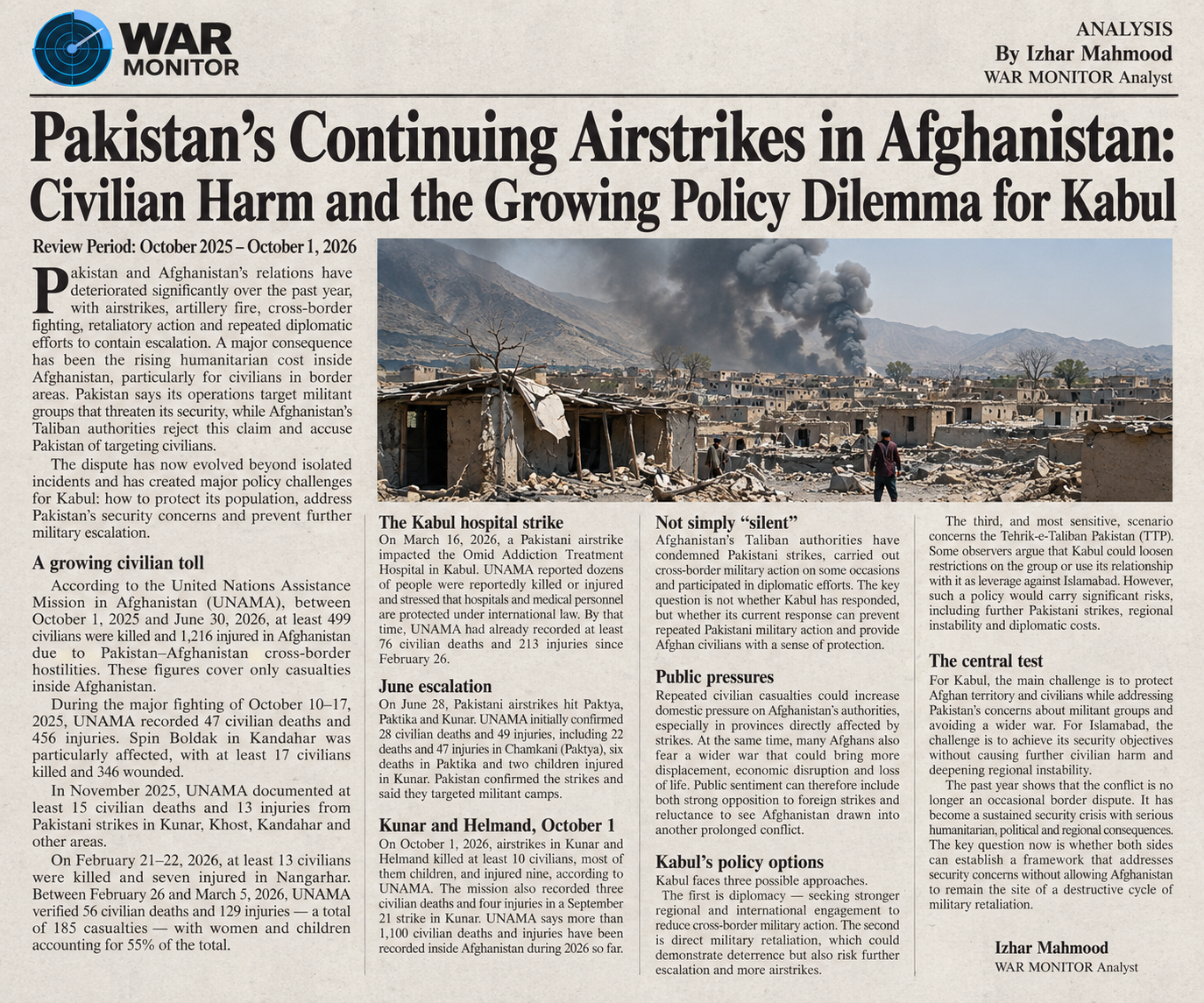
UNAMA has documented substantial civilian casualties from Pakistan-Afghanistan cross-border hostilities.
During the major fighting of October 2025, UNAMA recorded 47 civilians killed and 456 injured in Afghanistan between October 10 and 17. Spin Boldak in Kandahar was particularly affected, with preliminary UN figures recording at least 17 civilians killed and 346 wounded there.
Violence continued into 2026. During Pakistani airstrikes in Nangarhar on February 21–22, UNAMA recorded at least 13 civilians killed and seven injured, including women and children.
The confrontation intensified significantly between February 26 and March 5. UNAMA verified 185 civilian casualties inside Afghanistan — 56 killed and 129 injured — from aerial attacks and indirect fire during that period. Women and children accounted for 55 percent of the recorded casualties.
These figures demonstrate that the humanitarian impact is no longer attributable to a single isolated confrontation.
The Kabul Hospital Strike
A particularly consequential episode occurred on March 16, 2026, when a Pakistani airstrike impacted the Omid Addiction Treatment Hospital in Kabul.
UNAMA reported that dozens of people were reportedly killed or injured and emphasized that hospitals, medical personnel and patients receive special protection under international law. Before that incident, UNAMA had already recorded at least 76 civilian deaths and 213 injuries since February 26.
The significance of the incident went beyond its immediate casualties. The conflict had moved beyond Afghanistan’s border provinces and reached the capital itself.
That development raised the political stakes for Kabul while further complicating efforts to contain the confrontation geographically.
June Brought Another Major Escalation
On June 28, Pakistani airstrikes hit Paktya, Paktika and Kunar.
UNAMA initially confirmed at least 28 civilians killed and 49 injured. In Chamkani district of Paktya alone, it recorded 22 civilians killed and at least 47 injured. Six civilians were killed in Gyan district of Paktika, while two children were injured in Kunar.
Pakistan’s Ministry of Information and Broadcasting confirmed that Pakistani security forces had conducted strikes in the three provinces.
The episode illustrated the central disagreement that continues to define the conflict: Islamabad presents its cross-border operations through a counterterrorism framework, while Afghan authorities and international monitoring have repeatedly raised concerns about civilian casualties.
October 1: Kunar and Helmand Struck Again
The latest escalation came on October 1, 2026, when airstrikes hit Kunar and Helmand provinces.
UNAMA has confirmed that at least 10 civilians were killed, most of them children, while nine others were injured. The mission also noted that another airstrike in Kunar on September 21 had killed at least three civilians and injured four.
According to UNAMA, cross-border armed violence has now caused more than 1,100 civilian deaths and injuries inside Afghanistan during 2026 alone.
Pakistan, meanwhile, has said its October 1 operation targeted militant camps at two locations inside Afghanistan and claimed that 22 militants were killed.
The competing accounts underline the information problem surrounding the conflict: military objectives and casualty assessments provided by the parties frequently differ, making independent monitoring particularly important.
Kabul Is Not Simply “Silent”
Describing Afghanistan’s Taliban authorities as completely silent in response to Pakistani military action would be inaccurate.
Afghan authorities have publicly condemned Pakistani strikes, engaged Pakistani forces during periods of border fighting and participated in diplomatic efforts intended to contain escalation.
The more relevant question is therefore not whether Kabul has responded.
It is whether Kabul’s existing response can prevent repeated Pakistani military action while satisfying domestic expectations that Afghanistan’s territory and civilian population should be protected.
That distinction matters.
Public condemnation can demonstrate political opposition to an attack, but it does not necessarily produce deterrence. Military retaliation can demonstrate willingness to respond, but it may simultaneously increase the probability of another escalation.
Kabul therefore faces a difficult balance between deterrence and restraint.
Two Pressures on Afghan Public Opinion
Repeated civilian casualties could create increasing pressure on Afghanistan’s authorities, particularly in provinces directly exposed to cross-border violence.
At the same time, it would be simplistic to assume that public anger automatically translates into support for a broader war with Pakistan.
Afghanistan has experienced decades of conflict, displacement and economic disruption. Communities affected by cross-border fighting can therefore hold two positions simultaneously: opposition to foreign military strikes and opposition to another prolonged regional war.
This creates a difficult political environment for Kabul.
A limited response may be perceived by some Afghans as inadequate. A major military escalation, however, could produce further airstrikes, displacement, border closures and economic disruption.
The wider consequences are already visible. A UN Secretary-General report noted that Afghanistan-Pakistan hostilities have caused civilian casualties and displacement while damaging infrastructure, disrupting essential services, restricting trade and supply chains and obstructing humanitarian assistance.
Kabul’s First Option: Diplomacy and Regional Pressure
The least escalatory option remains diplomacy.
Afghanistan could seek stronger involvement from regional actors and international institutions capable of maintaining communication between Kabul and Islamabad and establishing mechanisms to reduce cross-border military action.
The central difficulty is that diplomacy cannot succeed sustainably unless the underlying security dispute is also addressed.
Pakistan maintains that armed groups operating from Afghanistan — particularly the Tehrik-e-Taliban Pakistan (TTP) — constitute a major threat to its territory.
Kabul, meanwhile, disputes key elements of Pakistan’s allegations and has objected to Islamabad conducting military operations inside Afghanistan.
Without progress on that fundamental disagreement, ceasefires may reduce violence temporarily without resolving the conditions that repeatedly produce new confrontations.
Second Option: Direct Military Retaliation
Afghanistan could also respond more forcefully along the border.
Such action could be intended to demonstrate that Pakistani strikes carry military costs and that Afghanistan retains the ability to retaliate.
But this approach carries obvious risks.
Pakistan possesses significantly greater conventional air capabilities. A cycle in which Afghan ground forces retaliate across the border and Pakistan responds with additional airstrikes could widen rather than contain the confrontation.
For Kabul, therefore, military retaliation presents a deterrence dilemma: a response intended to prevent future attacks could instead trigger another round of escalation.
The Most Sensitive Scenario: TTP as Leverage
A third and considerably more dangerous scenario concerns Kabul’s future approach toward the TTP.
One question increasingly relevant to the Pakistan-Afghanistan security relationship is whether continued Pakistani military pressure could lead Afghanistan’s Taliban authorities to reduce restrictions on the TTP, tolerate greater freedom of action by the group, or use their relationship with it as leverage against Islamabad.
There is an important distinction between examining this scenario and advocating it.
Any Afghan policy that materially expanded the TTP’s operational freedom or provided it with support would represent a major escalation in the bilateral confrontation. Islamabad already considers the TTP threat emanating from Afghanistan a central national-security concern.
Such a development could therefore provide Pakistan with additional justification for cross-border military action and potentially broaden the conflict rather than deter it.
It could also impose diplomatic costs on Kabul by reinforcing international concerns about armed groups operating from Afghan territory.
The TTP option should consequently be understood not as an obvious solution for Kabul, but as one of the highest-risk escalation scenarios available to it.
The Central Test for Kabul
The fundamental challenge facing Afghanistan’s Taliban authorities is broader than deciding whether to retaliate militarily.
Kabul must demonstrate that it can protect Afghan territory and civilians while simultaneously addressing allegations that armed groups based in Afghanistan threaten neighboring states.
Failure on the first issue risks increasing domestic frustration as civilian casualties continue.
Failure on the second risks sustaining the security rationale Islamabad uses for cross-border operations.
This leaves Kabul with a difficult strategic equation: how can it create credible deterrence against further Pakistani strikes without adopting policies that make those strikes more likely?
Islamabad Faces Its Own Strategic Calculation
Pakistan confronts a corresponding dilemma.
Cross-border strikes may disrupt particular militant networks or facilities, but their longer-term effectiveness cannot be assessed solely through immediate battlefield results.
Civilian casualties, diplomatic deterioration, anti-Pakistan sentiment inside Afghanistan and the possibility of retaliatory escalation must also be considered when evaluating their strategic consequences.
UNAMA has repeatedly called for de-escalation, dialogue and compliance with international law to prevent further civilian harm.
The events between October 2025 and October 2026 suggest that the Pakistan-Afghanistan confrontation is no longer an occasional border dispute.
It has developed into a sustained security crisis involving militant violence, conventional military force, competing sovereignty claims, civilian casualties and regional diplomacy.
The decisive question for the coming period will therefore not simply be whether another strike occurs, but whether Islamabad and Kabul can establish a security arrangement capable of addressing Pakistan’s concerns about cross-border militancy without allowing Afghanistan to become the arena for an increasingly destructive cycle of military retaliation.
Analysis by Izhar Mahmood — WAR MONITOR Analyst
X: https://x.com/warmonitorpakaf
Telegram: https://t.me/war_monitor10
Sources & verification
Reported by media or local sources. How we label claims
Read next
Related coverage
Afghan Taliban and TTP: Can Political Borders Separate a Shared Ideological and Historical Legacy?
Pakistan Alleges Kandahar Meeting Between Taliban Officials and Militant Leaders; Kabul Rejects Claim
Diplomatic Openings, the Smell of Explosives and the New Question of Proxy Warfare