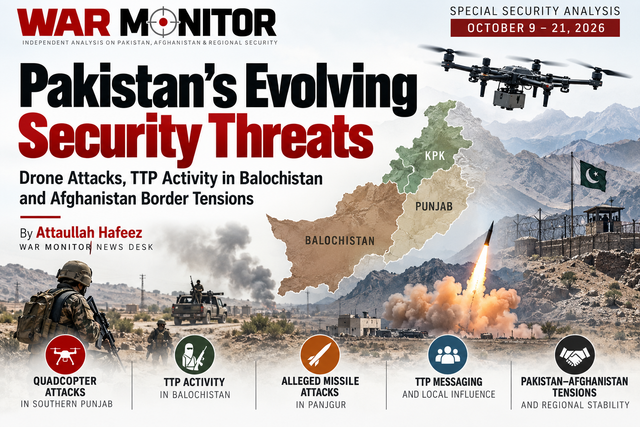
Ideological Rivals, Tactical Partners: How Pragmatism Is Reshaping Militant Alliances
- Published
- Updated
- Reading time
- 10 min read
Analysis by Izhar Mahmood — WAR MONITOR
September 24, 2026
The contemporary landscape of armed non-state actors is becoming increasingly difficult to understand through ideology alone. From Syria and Mali to Yemen, Somalia and the Afghanistan-Pakistan region, armed movements with sharply different political or religious objectives have shown a willingness to cooperate when battlefield realities create a shared interest.
The emerging pattern does not necessarily mean ideology has ceased to matter. Rather, it suggests that ideological purity and tactical pragmatism can operate simultaneously. Groups may retain rigid public doctrines while creating practical exceptions when they need manpower, weapons, logistics, territorial access, intelligence networks or assistance against a common adversary.
This raises a broader analytical question: How do ideological armed movements justify cooperation with actors whose political objectives they would otherwise reject — particularly when they criticise similar compromises made by their rivals?
Yemen and Somalia: Cooperation Across an Ideological Divide
The reported relationship between Yemen’s Houthis and Somalia’s Al-Shabaab provides one of the clearest examples of this phenomenon.
The two movements emerge from very different religious and political traditions. Yet a United Nations Panel of Experts reported increased smuggling and cooperation between them. The Panel reviewed information concerning weapons transfers, alleged Houthi training of Al-Shabaab members in Yemen, and training related to improvised explosive devices, drone adaptation and weapons maintenance. It also examined evidence concerning individuals allegedly facilitating contacts between the two sides.
The significance of the case lies precisely in the ideological distance between the actors.
Their interaction does not demonstrate ideological convergence. Instead, it illustrates how transactional security interests can create channels of cooperation despite substantial doctrinal differences.
This distinction — cooperation without ideological unification — is central to understanding similar developments elsewhere.
Mali and Azawad: Jihadists and Tuareg Nationalists
Mali offers an even more striking case.
To understand it, Azawad must first be understood. The term refers broadly to northern Mali, where Tuareg-led movements have pursued varying forms of autonomy or independence for decades. Tuareg separatists declared an independent Azawad in 2012, although the declaration received no international recognition.
The current Azawad Liberation Front (FLA) represents a predominantly Tuareg nationalist and separatist coalition. Its political project is fundamentally different from that of Jama’at Nusrat al-Islam wal-Muslimin (JNIM), the Al-Qaeda-affiliated jihadist coalition operating across the Sahel.
JNIM’s ideological project is Islamist and transnational in orientation. The FLA’s struggle is rooted primarily in the political future of Azawad and Tuareg nationalism.
Yet in 2026 these ideological differences did not prevent military cooperation.
On April 25, Reuters reported that JNIM claimed joint responsibility with the Tuareg-dominated FLA for coordinated attacks across Mali.
This relationship should not be interpreted as evidence that the FLA has adopted Al-Qaeda’s ideology, or that JNIM has embraced Tuareg separatism. It is better understood as an alignment in which different movements retain separate objectives while identifying a common battlefield interest.
The FLA Is Not Simply a Junior JNIM Proxy
Another distinction is important.
The FLA should not be reduced to a small tribal auxiliary operating under JNIM.
Available evidence does not establish that the FLA has more fighters overall than JNIM. JNIM operates a much broader regional militant network across the Sahel. But raw manpower alone does not determine influence in northern Mali.
The FLA draws strength from local Tuareg networks, political legitimacy among parts of the Azawad constituency, familiarity with northern Mali’s terrain, established armed structures and deep social and kinship connections.
JNIM brings different advantages: a broader militant network, greater geographic reach and substantial operational resources.
There are also social connections that make cooperation easier than their ideological positions might suggest. JNIM leader Iyad Ag Ghaly is himself a Tuareg and emerged from northern Mali’s earlier Tuareg political and armed environment before becoming a prominent jihadist leader.
The resulting relationship is therefore important precisely because the two sides can offer complementary capabilities.
The central question is not simply which organisation is larger.
It is what each organisation possesses that the other needs.
For JNIM, cooperation with Azawad nationalists can provide stronger access to local networks and armed structures in northern Mali. For the FLA, cooperation with JNIM can provide access to a broader militant network and additional military resources.
Mali therefore demonstrates one of the central arguments of this analysis: an ideological alliance is not required for a tactical alliance to become useful.
AQIS and Baloch Nationalist Militancy: An Emerging Test Case
This question is becoming increasingly relevant in South Asia.
Al-Qaeda in the Indian Subcontinent (AQIS) and Baloch nationalist armed organisations emerge from fundamentally different ideological traditions.
AQIS presents itself through a transnational jihadist framework. The Baloch Liberation Army (BLA) and related Baloch separatist currents are primarily rooted in Baloch nationalism and the pursuit of political independence or sovereignty.
On paper, the ideological distance is considerable.
Nevertheless, information available to WAR MONITOR, alongside recent reporting concerning militant networks operating between Afghanistan and Pakistan, points toward growing contacts between AQIS-linked elements and Baloch nationalist militants.
Reports concerning contacts involving BLA leader Bashir Zeb and AQIS-linked representatives have also emerged from Pakistani sources. Claims have extended to training, manpower and other forms of assistance.
WAR MONITOR’s source-based assessment is that these developments warrant examination as an emerging tactical alignment rather than merely incidental contact.
However, an important evidentiary distinction must remain clear: the precise command relationship, scale of personnel transfers and claims that specific AQIS fighters are operating directly under BLA structures have not all been independently established.
That distinction does not diminish the analytical importance of the relationship. It identifies what is known, what is reported and what still requires corroboration.
If AQIS-linked militants are increasingly cooperating with Baloch nationalist armed actors, a fundamental ideological question follows:
How does a jihadist organisation reconcile operational cooperation under a nationalist armed framework with its own rejection of nationalism as an ideological project?
That question becomes particularly significant when AQIS’s position on developments in Syria is considered.
Syria: AQIS Criticism and the Limits of Pragmatism
Syria presents the other side of the argument.
Ahmed al-Sharaa’s transformation from the leader of Hayat Tahrir al-Sham (HTS) into Syria’s president has required precisely the kind of political pragmatism that armed ideological movements often face when moving from insurgency toward governance.
HTS itself emerged from a jihadist environment but formally separated from Al-Qaeda years before taking Damascus. Al-Sharaa’s subsequent government has pursued international diplomatic relations and the consolidation of armed factions into state institutions.
AQIS’s response is particularly revealing.
AQIS initially welcomed the military developments that led to Bashar al-Assad’s fall but conspicuously avoided directly praising HTS or al-Sharaa. As al-Sharaa expanded diplomatic engagement with Western and regional governments, criticism grew within AQIS-linked circles. In May 2025, AQIS’s principal Urdu publication carried material presenting the capture of Damascus in sharply critical terms and challenging the legitimacy of the political compromises surrounding the new order.
The underlying issue is therefore broader than any single agreement involving Syria’s Kurds or another faction.
It concerns whether a former jihadist movement can obtain power and then participate in state politics, international diplomacy, institutional integration and compromise with ideologically different actors without being accused by former ideological allies of abandoning its original principles.
This is where the comparison becomes analytically significant.
If political compromise with ideologically different actors is treated as evidence of ideological deviation in Syria, how should tactical cooperation between jihadist organisations and nationalist armed movements elsewhere be understood?
The situations are not identical, and direct equivalence would be misleading. But the comparison exposes an important tension between doctrinal rhetoric and operational necessity.
Three Levels: Ideology, Battlefield and Propaganda
These cases suggest that the behaviour of armed ideological organisations can usefully be examined on three separate levels.
At the ideological level, organisations emphasise doctrine, religious legitimacy, political objectives and loyalty to their declared principles.
At the operational level, survival and battlefield requirements can produce a different calculation. A group may require weapons, manpower, intelligence, logistics, territorial access or assistance against a common adversary. Under those circumstances, ideological differences may become temporarily negotiable.
At the propaganda level, another distinction emerges. An organisation can describe its own compromises as necessity, strategy or temporary cooperation while characterising similar compromises by a rival as ideological betrayal.
Reducing this phenomenon simply to “hypocrisy” risks obscuring how armed organisations actually function.
Two more useful analytical concepts are organisational pragmatism and selective ideological justification.
The ideology does not necessarily disappear. Instead, organisations determine which ideological boundaries are absolute and which can be temporarily reinterpreted when operational interests require it.
Why the AQIS-Baloch Relationship Matters
This makes the emerging relationship between AQIS-linked elements and Baloch nationalist militancy particularly important for security analysis.
The issue is not simply whether two armed organisations communicate with each other.
If cooperation develops across training, manpower, logistics or operational facilitation, it would demonstrate the ability of ideologically different militant ecosystems to exchange capabilities without merging their political projects.
That would have practical implications.
A transnational jihadist network can potentially contribute expertise or personnel, while a locally rooted nationalist insurgency can provide geographic access, established local networks and a distinct operational environment.
Mali provides a useful comparison precisely because JNIM and the FLA have not needed to resolve their ideological differences before cooperating against a shared adversary.
The same analytical framework can therefore help assess developments involving AQIS and Baloch armed groups — while recognising that the evidence, history and organisational structures in the two theatres are different.
The Broader Pattern
Taken together, the cases from Mali, Yemen, Somalia, Syria and South Asia challenge the assumption that ideological compatibility is a prerequisite for cooperation among armed non-state actors.
They do not demonstrate that ideology has become irrelevant.
Instead, they suggest something more nuanced:
Ideology defines long-term identity and objectives, while tactical necessity can determine short-term partners.
This distinction helps explain how a jihadist organisation can cooperate with nationalists without becoming nationalist, or how actors separated by substantial sectarian differences can maintain transactional security contacts without resolving those differences.
It also explains why analysing armed organisations exclusively through their manifestos can be misleading.
Their actual behaviour may be shaped as much by geography, resources, local relationships, battlefield pressure and organisational survival as by their published ideological positions.
Conclusion
The contemporary militant environment increasingly requires analysts to distinguish between ideological affiliation and operational alignment.
Mali provides perhaps the clearest current illustration. JNIM and the Azawad Liberation Front retain fundamentally different political visions, yet their cooperation shows how a shared adversary and complementary capabilities can temporarily outweigh ideological incompatibility. Their relationship does not require either side to abandon its ultimate objective.
The Houthi-Al-Shabaab case similarly demonstrates that substantial religious differences do not necessarily prevent transactional relationships involving weapons, training or logistics. UN investigators have documented information pointing to an increasingly developed relationship between those networks.
South Asia may now be producing another important case. Reports of expanding contacts between AQIS-linked networks and Baloch nationalist militants raise questions about how far tactical cooperation can develop between actors whose ultimate ideological objectives remain fundamentally different.
At the same time, AQIS’s criticism of al-Sharaa’s political evolution in Syria provides an important contrast. AQIS-linked discourse has criticised the compromises associated with Syria’s post-Assad political transition even as armed Islamist movements elsewhere demonstrate considerable flexibility in choosing battlefield partners.
The central conclusion, therefore, is not that ideology has disappeared.
It is that ideological rigidity and operational pragmatism can coexist within the same organisation.
For security and counterterrorism analysis, the critical question should no longer be only:
“What does this organisation believe?”
It should also be:
“What does this organisation currently need — and which actors can provide it?”
Understanding manpower requirements, geography, weapons access, logistics, local networks and common adversaries may increasingly provide a better indication of potential militant partnerships than ideological declarations alone.
In today’s armed conflicts, ideology continues to define identity. Operational necessity, however, can determine alliances — including alliances that ideology itself would appear to prohibit.
Analysis by Izhar Mahmood
WAR MONITOR
Website: https://warmonitorpk.com
X: https://x.com/warmonitorpakaf
Telegram: https://t.me/war_monitor10
Sources & verification
Reported by media or local sources. How we label claims
Read next
Related coverage
Afghanistan, Paktika: Clashes Erupt in Response to Drone Strikes in Angoor Adda; Pakistani Casualties Claimed
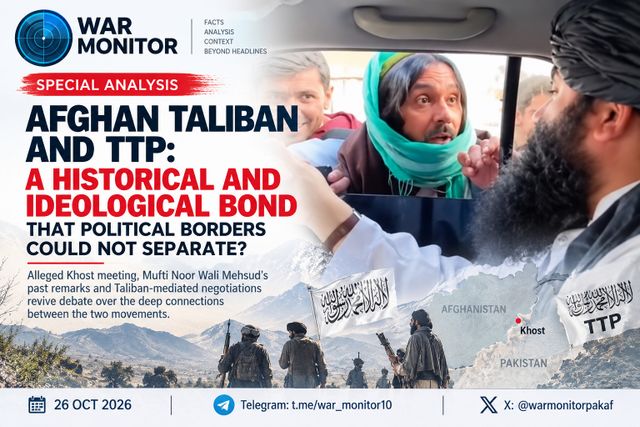
Afghan Taliban and TTP: Can Political Borders Separate a Shared Ideological and Historical Legacy?
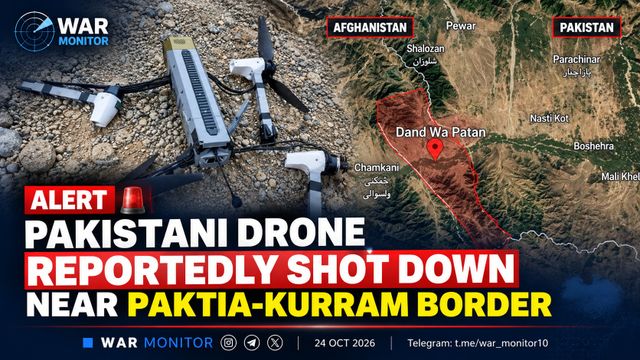
Pakistani Drone Reportedly Shot Down Near Afghanistan-Pakistan Border in Paktia