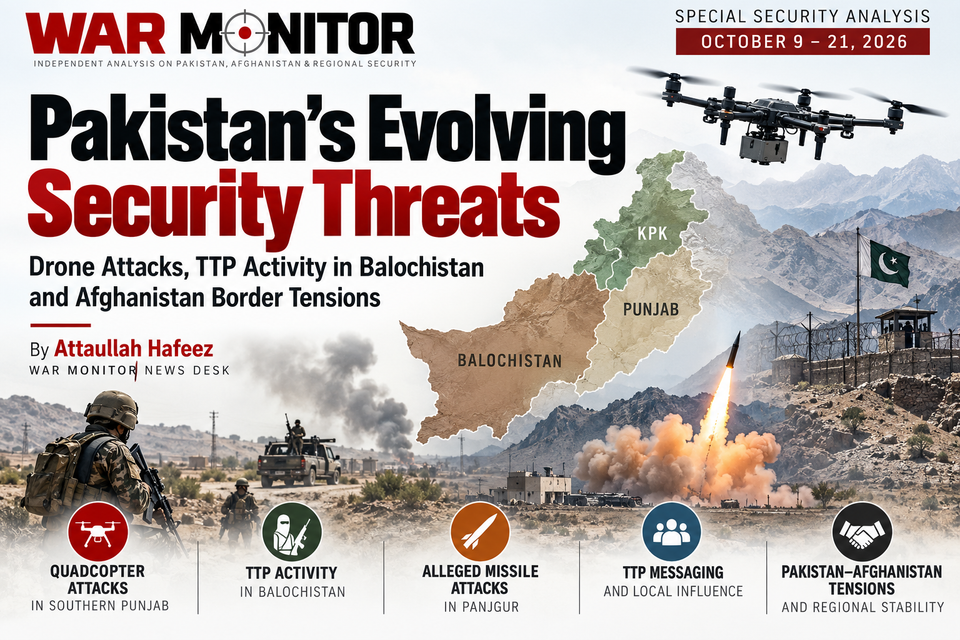
Pakistan’s Evolving Security Threats: Drone Attacks, TTP Activity in Balochistan and Afghanistan Border Tensions
War Monitor English Report
WAR_MONITOR_Special_Security_Analysis_21_Oct_2026
War Monitor Urdu Report
WAR_MONITOR_Urdu_Security_Analysis_21_Oct_2026
Special Security Analysis | October 9–21, 2026
By Attaullah Hafeez | WAR MONITOR News Desk
Executive Summary
Pakistan’s security environment remained volatile during the second and third weeks of October 2026, with reported militant attacks, abductions, security operations and cross-border tensions affecting several regions.
Three developments warrant particular attention: the use of quadcopter drones in attacks on police facilities in southern Punjab, reported efforts by the banned Tehreek-e-Taliban Pakistan (TTP) to expand its activities in Balochistan, and the release of footage purporting to show missile and mortar attacks in Panjgur.
The TTP’s communication activities relating to Balochistan also raise questions about its attempts to reach new audiences and establish a broader regional presence.
Meanwhile, tensions between Pakistan and Afghanistan continued to complicate the regional security environment.
Although available figures indicate a decline in militant attacks during one week of October, developments across several provinces suggest that Pakistan faces an increasingly diverse range of security challenges.
1. National Security Overview: Fewer Attacks, Persistent Threats
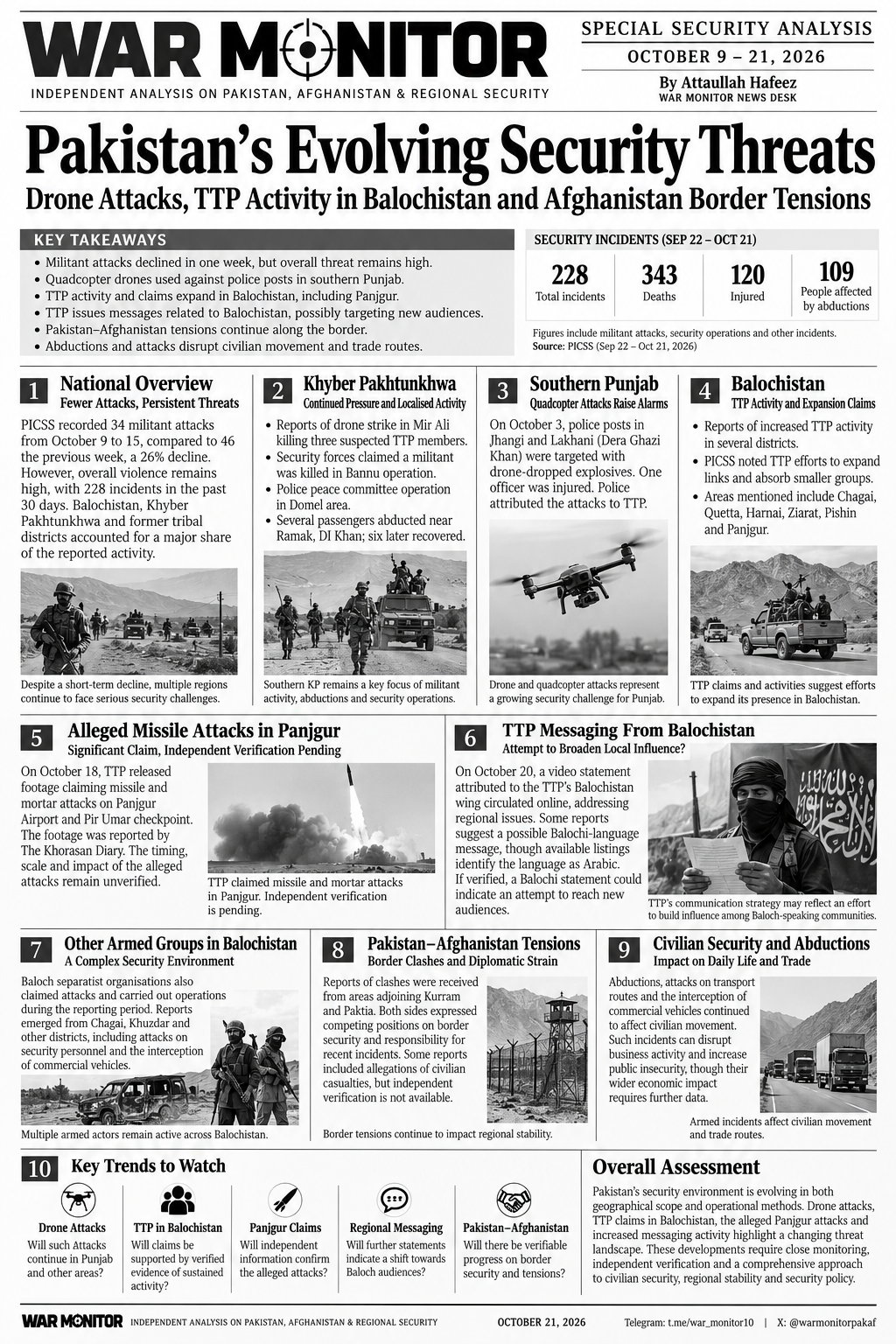
According to the Pakistan Institute for Conflict and Security Studies (PICSS), 34 militant attacks were recorded nationwide between October 9 and 15, compared with 46 during the preceding week.
This represented a decline of approximately 26%.
However, a reduction over a single week does not necessarily indicate a sustained improvement in the overall security situation.
PICSS data covering the 30-day period from September 22 to October 21 recorded 228 security-related incidents, 343 deaths, 120 injuries and 109 people affected by abductions.
These figures include different categories of security incidents, including militant attacks and security operations, and should not be interpreted as militant attack statistics alone.
The geographical distribution of incidents also varied considerably, with Balochistan, Khyber Pakhtunkhwa and the former tribal districts accounting for substantial portions of the reported activity.
Analysis
Assessing Pakistan’s security environment requires more than counting attacks.
Casualties, abductions, geographical distribution, civilian exposure and changes in militant methods are equally important indicators.
A temporary decline in attacks may coexist with the emergence of new threats or the expansion of armed activity into additional areas.
2. Khyber Pakhtunkhwa: Continuing Pressure and Localised Militant Activity
Khyber Pakhtunkhwa remained a major focus of security-related developments, particularly in North Waziristan, Bannu, Dera Ismail Khan, Tank and other southern districts.
During the reporting period, local and security-related sources described several incidents involving suspected militants and law enforcement personnel.
In North Waziristan, reports attributed to Insurgent Zone indicated that three suspected TTP members were killed in an alleged drone strike on a house in the Mir Ali area.
Separately, state-affiliated accounts claimed that security forces killed a suspected militant during an intelligence-based operation in Bannu district.
Reports also emerged of an operation involving a police peace committee in the Domel area of Bannu.
Independent verification of the circumstances and casualties in these incidents remains pending.
In Dera Ismail Khan, several passengers were reportedly abducted after armed individuals intercepted a vehicle near Ramak. Subsequent local reports indicated that six passengers had been recovered.
Analysis
The continuing incidents across southern Khyber Pakhtunkhwa demonstrate that the security challenge extends beyond large-scale militant attacks.
Abductions, smaller armed incidents and operations against suspected militant locations can affect public confidence, transport networks and everyday civilian activity.
However, individual incidents should not automatically be interpreted as evidence of a broader organisational advance or retreat without corroborating information.
3. Quadcopter Attacks in Southern Punjab: An Emerging and Persistent Security Challenge
The reported use of small drones and quadcopters in attacks against police facilities represents a significant development in Pakistan’s domestic security environment.
On October 3, police reported drone attacks targeting the Jhangi and Lakhani police posts near the Punjab–Khyber Pakhtunkhwa boundary in Dera Ghazi Khan district.
District Police Officer Sadiq Baloch said explosive devices were dropped during the attacks, leaving one police officer slightly injured.
Police attributed the incidents to militants associated with the TTP.
Although the attacks occurred before the principal reporting period, they remain relevant to assessing the evolving security threats facing southern Punjab.
Analysis
The use of commercially available drone technology by armed groups presents additional challenges for conventional policing and the protection of public facilities.
The incidents suggest that threats previously associated primarily with parts of Khyber Pakhtunkhwa may also affect neighbouring districts in Punjab.
Three broader implications emerge.
First, police facilities may require updated protective measures reflecting the changing nature of attacks.
Second, drone attacks near populated areas create risks for civilians and surrounding infrastructure.
Third, coordination between law enforcement and security agencies becomes increasingly important as these threats evolve.
Nevertheless, the scale of the threat should be assessed through independently documented incidents rather than isolated claims.
4. TTP Activity in Balochistan: Questions Over Geographical Expansion
Armed violence in Balochistan has traditionally been examined largely in the context of Baloch separatist organisations.
However, recent statements, organisational announcements and reported attacks attributed to the banned TTP suggest that the province is also becoming increasingly relevant to the group’s regional strategy.
In its July–September 2026 assessment, PICSS discussed reported TTP efforts to expand organisational links and absorb smaller armed factions in different regions, including Balochistan.
The assessment referred to developments involving areas such as Chagai, Quetta, Harnai, Ziarat, Pishin and Panjgur.
Claims involving Panjgur are particularly noteworthy because the district lies within a predominantly Baloch region, outside the TTP’s traditional centres of activity.
Analysis
The TTP’s presence in Balochistan is not entirely new.
The more significant question is whether recent developments indicate a measurable expansion in its geographical reach, local networks or operational activity.
Statements announcing new affiliations or claiming attacks may indicate organisational ambitions, but they do not independently establish sustained control, recruitment or increased militant strength.
It is also essential to distinguish the TTP from Baloch separatist organisations, which have different political objectives, organisational structures and histories.
Conflating their activities could obscure important differences in Balochistan’s security landscape.
5. Alleged Missile Attacks in Panjgur: A Significant but Unverified Claim
On October 18, the TTP released footage that it claimed showed mortar and missile attacks targeting Panjgur Airport and the Pir Umar checkpoint in Balochistan.
The release of the footage was also reported by The Khorasan Diary, which monitors militant activity and regional security developments.
However, the existence of the footage does not independently establish when the alleged attacks occurred, which weapons were used, whether the reported targets were struck or whether any casualties resulted.
Analysis
The Panjgur claims are significant for two reasons.
First, they represent an attempt by the TTP to demonstrate activity in a region beyond its traditional geographical strongholds.
Second, the claimed use of missiles and mortars raises questions about the protection of security installations, although the precise nature of the alleged attacks remains unverified.
If independently confirmed, these incidents would be relevant to understanding the TTP’s activities in Balochistan.
Until then, they should be described as organisational claims rather than established attacks.
Independent verification is pending.
6. TTP Messaging From Balochistan: An Attempt to Broaden Local Influence?
Another important development concerns the TTP’s communication strategy relating to Balochistan.
On October 20, a video statement attributed to the group’s Balochistan wing circulated online, addressing regional political and social issues.
The Khorasan Diary recorded a video release associated with the group’s Balochistan wing, although its available listing identified the language as Arabic.
Separate reports concerning a statement in the Balochi language require verification against the original material.
If a Balochi-language statement is authenticated, it could indicate an effort by the TTP to communicate more directly with Baloch-speaking communities.
Analysis
The activities of an armed organisation cannot be assessed solely through attacks and casualties.
Its communication strategy, recruitment claims, organisational affiliations and attempts to address local grievances may also reveal its broader objectives.
TTP messaging focused on Balochistan suggests an effort to incorporate provincial issues into its wider narrative.
A verified Balochi-language statement would be particularly relevant because it could demonstrate an attempt to reach audiences outside the organisation’s traditional linguistic and geographical base.
However, increased propaganda activity does not necessarily demonstrate increased military capability, successful recruitment or widespread local support.
Such conclusions require independent evidence.
The combination of organisational claims, messaging activities and alleged incidents in Panjgur warrants continued scrutiny, but it does not yet establish a definitive increase in the group’s operational strength.
7. Other Armed Groups in Balochistan: A Complex Security Environment
Balochistan’s security challenges cannot be understood through TTP-related developments alone.
During the reporting period, incidents involving armed attacks, abductions, security operations and the interception of commercial vehicles were reported in several districts.
Reports emerged from Chagai, Khuzdar and other areas concerning armed activity affecting security personnel, transport routes and local communities.
Baloch separatist organisations also issued claims concerning attacks and casualties, although independent confirmation was not available for every reported incident.
Analysis
Balochistan faces multiple, distinct forms of armed violence.
The activities of Baloch separatist groups, the TTP and other armed actors should be examined separately, with careful attention to their stated objectives and independently established actions.
The impact of violence on commercial transport, road access, civilian movement and local economic activity is also central to understanding the province’s security challenges.
8. Pakistan–Afghanistan Tensions and Regional Security
Security disagreements between Pakistan and Afghanistan remained a major concern during October.
Reports of border clashes emerged from areas adjoining Kurram district in Pakistan and Paktia province in Afghanistan.
Both sides have expressed competing positions on border security and responsibility for incidents affecting their respective territories.
Pakistani authorities have repeatedly identified the presence of armed groups operating against Pakistan from Afghan territory as a central security concern.
Afghan authorities have also raised objections to Pakistani actions and disputed allegations concerning cross-border militant activity.
Some reported incidents included allegations of civilian casualties, but the available accounts were not consistently supported by independent verification.
Analysis
Relations between Pakistan and Afghanistan are closely connected to wider regional security developments.
However, assigning responsibility for individual attacks requires credible evidence rather than assumptions based on geographical proximity or political disputes.
Diplomatic engagement, independent investigation of border incidents and measures to protect civilians remain important considerations.
The available evidence does not support a definitive prediction about whether tensions will increase or decrease in the coming weeks.
9. Civilian Security, Abductions and Economic Consequences
Armed violence and security operations have consequences extending beyond the immediate participants.
Reported abductions, attacks on transport routes and armed incidents involving commercial vehicles can disrupt civilian movement and affect public confidence.
The reported abduction of passengers near Ramak and incidents involving commercial transport in Balochistan illustrate these concerns.
However, their broader economic impact cannot be reliably quantified without additional evidence.
Analysis
The effectiveness of security measures should not be assessed solely through militant casualties or the number of operations conducted.
Civilian safety, freedom of movement, access to healthcare and education, and the continuity of commercial activity are also important indicators.
Distinguishing criminal abductions from politically motivated or militant-related kidnappings is essential to producing an accurate security assessment.
10. Key Security Developments to Monitor
Five issues deserve particular attention in subsequent weekly assessments.
Drone-related threats: Whether independently confirmed drone attacks continue in southern Punjab and other areas outside the traditional centres of militant violence.
TTP activity in Balochistan: Whether claims of organisational expansion are accompanied by verifiable evidence of sustained activity in additional districts.
The Panjgur claims: Whether credible information emerges confirming the alleged attacks, their timing and any resulting damage.
Regional messaging: Whether further authenticated statements demonstrate a sustained effort by the TTP to address Baloch-speaking communities.
Pakistan–Afghanistan relations: Whether diplomatic engagement produces verifiable progress on border security and disputes concerning militant activity.
Overall Assessment
The defining feature of Pakistan’s security environment between October 9 and 21 was not simply the continuation of armed violence, but the apparent diversification of threats.
The reported use of quadcopters in southern Punjab, TTP claims concerning Balochistan, the alleged missile attacks in Panjgur and efforts to address new regional audiences all warrant closer examination.
Taken together, these developments suggest that some armed organisations are attempting to broaden their geographical reach and adapt their methods of operation and communication.
However, claims of expansion must be distinguished from independently verified evidence of increased organisational strength.
Pakistan’s principal security challenge therefore involves not only preventing attacks but also protecting civilians, maintaining regional stability and adapting institutional responses to changing threats.
Editorial Note: This report reviews developments between October 9 and 21, 2026. Earlier incidents have been included where they provide relevant context. Claims issued by armed organisations have not been treated as independently established facts.
WAR MONITOR News Desk
Telegram: https://t.me/war_monitor10
X: https://x.com/warmonitorpakaf
Sources & verification
Reported by media or local sources. How we label claims
Read next
Related coverage
Two Pakistani Security Personnel Reportedly Killed in Kech Ambush; CPEC Route Bridge Destroyed
Armed Attack Reported on Construction Company Site in Gwadar, Balochistan
Pakistan Military Claims 74 Militants Killed in Operations Across Khyber Pakhtunkhwa and Balochistan
Baloch Nationalist Army Issues Statement Marking Baloch Martyrs’ Day on November 13
Region