Afghanistan’s Emerging Economic Strategy: Trade Corridors Take a More Prominent Role in Taliban Policy
- Published
- Updated
- Reading time
- 6 min read
Analysis by Izhar Mahmood — WAR MONITOR Analyst
October 5, 2026 | WAR MONITOR Analysis
Since the Taliban returned to power in Afghanistan, international attention has largely focused on security, militant groups, border tensions and the government’s domestic policies. Recent developments, however, point to another increasingly visible priority in Kabul: an effort to position Afghanistan as a regional hub for trade, transit and overland connectivity.
This does not mean that security or military considerations have become secondary for the Taliban government. Afghanistan continues to face serious security challenges, while tensions with Pakistan have repeatedly spilled across the border. Rather, the emerging picture suggests that economic connectivity is assuming a more prominent place alongside the Taliban’s traditional security-focused approach to statecraft.
Wakhan: More Than a Road to the Chinese Border
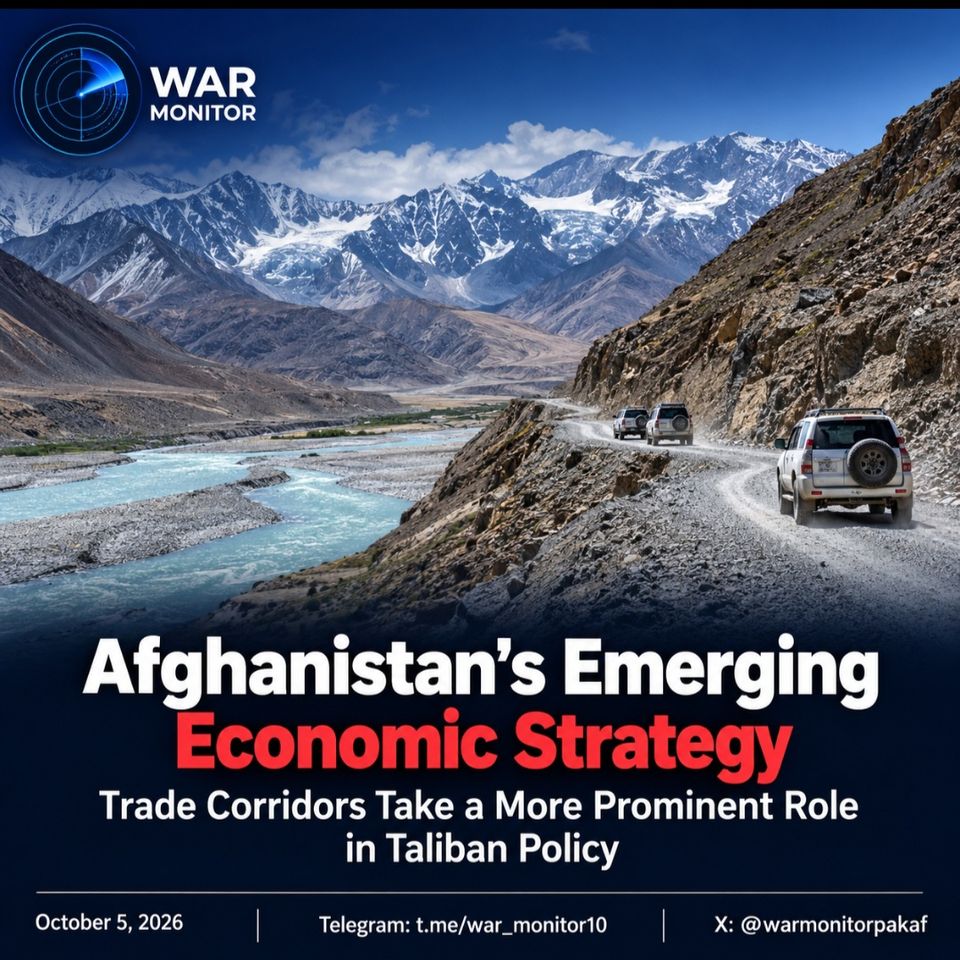
The latest and perhaps most symbolic development is the completion and inauguration of a 121-kilometre road through the Wakhan region of Badakhshan to Afghanistan’s border with China.
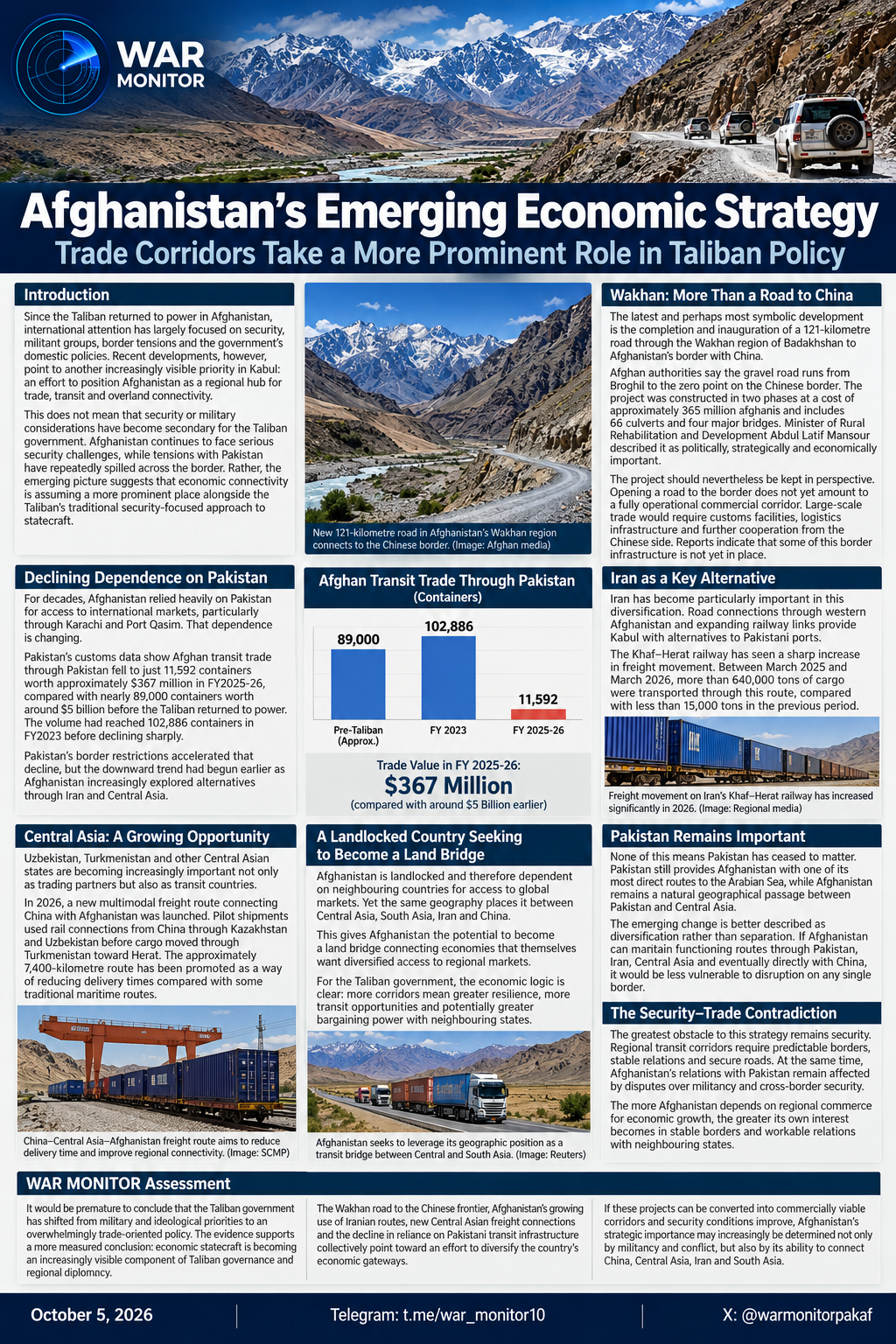
The gravel road runs from Broghil to the zero point on the Chinese border. Afghan authorities say it was constructed in two phases at a cost of approximately 365 million afghanis and includes 66 culverts and four major bridges. Minister of Rural Rehabilitation and Development Abdul Latif Mansour described the project as politically, strategically and economically important.
The significance of the project should nevertheless be kept in perspective.
Opening a road to the border does not yet amount to establishing a fully operational Afghanistan-China commercial corridor. Large-scale cross-border trade would require customs facilities, logistics infrastructure, commercial arrangements and cooperation from the Chinese side. Reports indicate that some of this border infrastructure is not yet in place.
Even so, the project carries considerable strategic significance. Kabul is attempting to turn Afghanistan’s remote geographical connection with China into a potential economic asset rather than leaving the Wakhan frontier largely isolated.
Reducing Dependence on a Single Transit Route.
For decades, Afghanistan relied heavily on Pakistan for access to international markets, particularly through Karachi and Port Qasim.
That dependence is changing.
Pakistan’s customs data cited by Dawn show Afghan transit trade through Pakistan falling to just 11,592 containers worth approximately $367 million in FY2025-26, compared with nearly 89,000 containers worth around $5 billion before the Taliban returned to power. The volume had reached 102,886 containers in FY2023 before declining sharply.
Pakistan’s border restrictions accelerated that decline, but the available data indicate that the downward trend had begun earlier as Afghanistan increasingly explored alternatives through Iran and Central Asia.
This distinction matters.
Kabul’s apparent objective is not necessarily to eliminate Pakistan from Afghanistan’s trade network. Geography makes that difficult and economically questionable. Instead, Afghanistan appears to be seeking multiple viable corridors so that disruption on one border does not paralyse its external trade.
Iran and Central Asia Gain Importance
Iran has become particularly important in this diversification.
Road connections through western Afghanistan and expanding railway links provide Kabul with alternatives to Pakistani ports. At the same time, Central Asian states are becoming increasingly important not only as trading partners but also as transit countries.
The trend became more visible in 2026 with the development of a new multimodal freight route connecting China with Afghanistan through Central Asia.
Pilot shipments launched in May used rail connections from China through Kazakhstan and Uzbekistan before cargo moved through Turkmenistan toward Herat. The approximately 7,400-kilometre route has been promoted as a way of reducing delivery times compared with some traditional maritime routes.
For Afghanistan, this development carries significance beyond bilateral trade with China.
If Kabul can establish reliable connections north toward Central Asia, west toward Iran, east toward China and south toward Pakistan, Afghanistan could gradually transform its geographical position from a liability into a source of transit revenue and political relevance.
A Landlocked Country Seeking to Become a Land Bridge
Afghanistan faces an unusual geographical paradox.
It is landlocked and therefore dependent on neighbouring countries for access to global markets. Yet the same geography places it between Central Asia, South Asia, Iran and China.
That gives Afghanistan the potential to become a land bridge connecting economies that themselves want diversified access to regional markets.
For the Taliban government, the economic logic is clear: more corridors mean greater resilience, more transit opportunities and potentially greater bargaining power with neighbouring states.
The Wakhan project therefore fits into a broader pattern rather than standing alone.
Pakistan Remains Important
None of this means Pakistan has ceased to matter.
Pakistan still provides Afghanistan with one of its most direct routes to the Arabian Sea, while Afghanistan remains a natural geographical passage between Pakistan and Central Asia.
The emerging change is therefore better described as diversification rather than separation.
If Afghanistan can maintain functioning routes through Pakistan, Iran, Central Asia and eventually directly with China, Kabul would be less vulnerable to political disputes or border closures involving any single neighbour.
That would have economic consequences, but it could also change the political balance in Afghanistan’s relations with its neighbours.
The Security–Trade Contradiction
The greatest obstacle to this strategy remains security.
Regional transit corridors require predictable borders, stable relations, secure roads and confidence among governments, investors and transport companies.
At the same time, Afghanistan’s relations with Pakistan remain heavily affected by disputes over militancy and cross-border security. Persistent instability can therefore work directly against Kabul’s ambitions to make Afghanistan a reliable commercial bridge.
This creates a fundamental tension in Taliban policy.
The more Afghanistan depends on regional commerce for economic growth, the greater its own interest becomes in stable borders and workable relations with neighbouring states.
Trade corridors cannot reach their full potential if the same borders repeatedly become points of military confrontation or prolonged closure.
WAR MONITOR Assessment
It would be premature to conclude that the Taliban government has shifted from military and ideological priorities to an overwhelmingly trade-oriented policy.
The evidence supports a more measured conclusion.
Economic statecraft is becoming an increasingly visible component of Taliban governance and regional diplomacy.
The Wakhan road to the Chinese frontier, Afghanistan’s growing use of Iranian routes, new Central Asian freight connections and the dramatic decline in reliance on Pakistani transit infrastructure collectively point toward an effort to diversify the country’s economic gateways.
The long-term significance of this strategy will depend on whether infrastructure projects can be converted into commercially viable corridors and whether Afghanistan can provide the political and security stability necessary for sustained regional trade.
If those conditions emerge, Afghanistan’s strategic importance may increasingly be determined not only by militancy, conflict and security competition, but also by its ability to connect China, Central Asia, Iran and South Asia.
That could become one of the more consequential — and comparatively less discussed — developments of the Taliban’s current period in power.
X: https://x.com/warmonitorpakaf
Telegram: https://t.me/war_monitor10
Sources & verification
Reported by media or local sources. How we label claims
Read next
Related coverage
Afghanistan, Paktika: Clashes Erupt in Response to Drone Strikes in Angoor Adda; Pakistani Casualties Claimed
Afghan Taliban and TTP: Can Political Borders Separate a Shared Ideological and Historical Legacy?
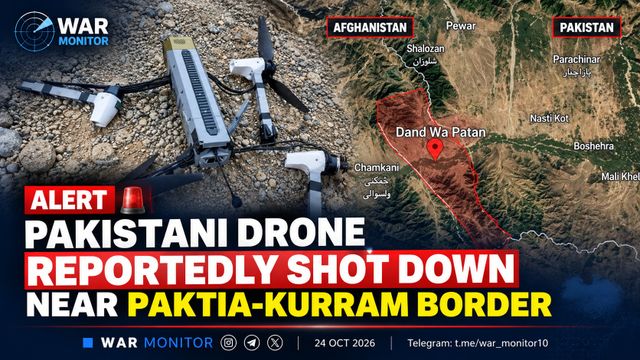
Pakistani Drone Reportedly Shot Down Near Afghanistan-Pakistan Border in Paktia