The Islamic State in Pakistan: Mapping Its Presence, Networks and Operational Evolution WAR MONITOR | Special Analytical Report | September 2026
- شائع
- اپ ڈیٹ
- پڑھنے کا وقت
- 10 منٹ کی پڑھائی
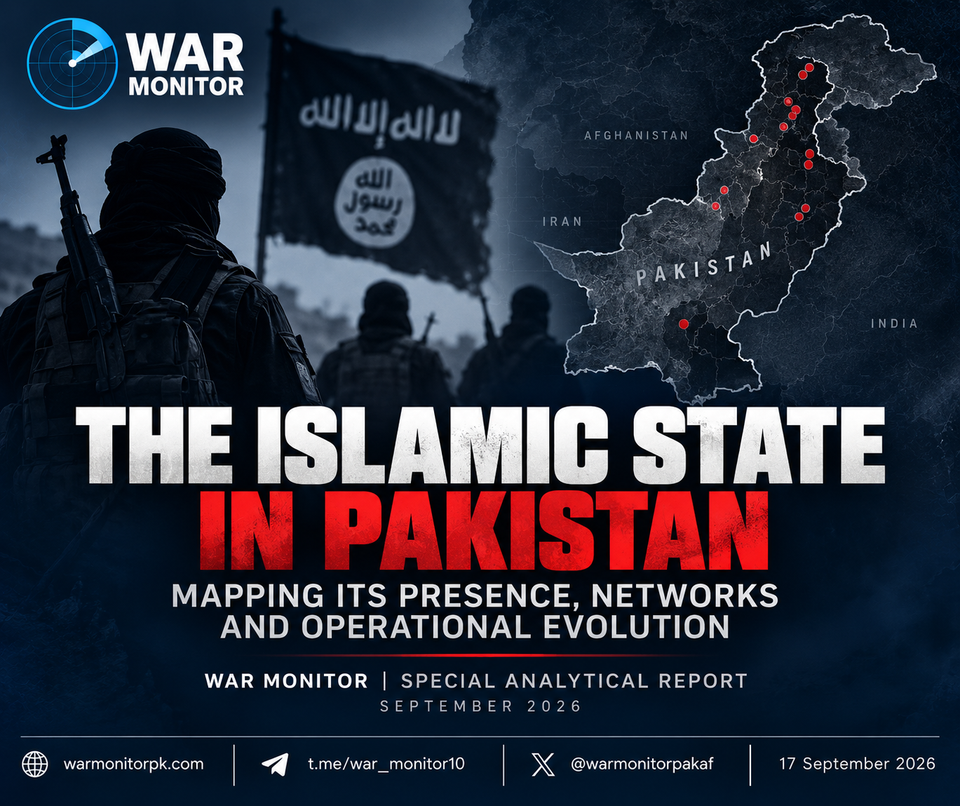
SPECIAL ANALYTICAL REPORT: Islamic State Networks in Pakistan
Origins, Structure and Current Trajectory
Published: September 2026
EXECUTIVE SUMMARY
A review of open-source reporting, incident records, and field information points to a fragmented but persistent network rather than a single, centrally coordinated nationwide insurgency. Islamic State-linked activity in Pakistan has historically relied on a combination of small local cells, ideological defectors from older militant organisations, sectarian networks, urban radical circles, and individuals emerging from pre-existing jihadist environments.
Administrative Distinctions: Since 2019, not all Islamic State activity in Pakistan should automatically be labelled ISKP. The Islamic State-Pakistan Province (ISPP) emerged as a separate administrative affiliate, particularly associated with activity in Balochistan, Sindh, Punjab, and other parts of Pakistan. This report uses “Islamic State networks” as a broader term where attribution remains unclear, while distinguishing between ISKP and ISPP where evidence allows.
Targeting Patterns: Islamic State activity in Pakistan cannot be understood solely through the lens of anti-state insurgency. Its operational record includes attacks on security forces, but also on religious parties, ulema, tribal elders, Shia communities, alleged informants, rival jihadists, and political gatherings, reflecting military priorities, ideological competition, sectarian warfare, and attempts to eliminate local rivals.
KEY FINDINGS
No Nationwide Infrastructure: Islamic State does not currently maintain a nationwide insurgent infrastructure comparable to TTP.
Fragmented Ecosystems: Its presence in Pakistan is fragmented across distinct local ecosystems rather than operating as one uniform network.
Ideological Divide: TTP and Islamic State are not interchangeable actors. TTP is rooted primarily in the Deobandi militant tradition, while Islamic State follows a Salafi-jihadist ideological framework.
Direct Armed Rivalry: In some areas, Orakzai, TTP and Islamic State have become direct armed rivals.
Field Verification: Field sources have verified the dismantling of the Ummati network and the close relationship between Ummati and Sadiq Yar.
Distinct Evolution in Balochistan: Islamic State-linked networks in Balochistan developed differently from those in Khyber Pakhtunkhwa, drawing partly from sectarian militant environments.
Targeted Operations: Islamic State activity in Pakistan is often targeted rather than territorial.
Persistence Despite Degradation: Organisational degradation should not be confused with organisational elimination.
WHY THIS REPORT MATTERS
Militant violence in Pakistan is frequently treated as part of a single jihadist landscape. That approach can lead to incorrect attribution. Attacks on religious parties, ulema, or tribal figures are often quickly linked in public discourse to TTP, even when Islamic State later claims responsibility or the target profile points toward a different militant actor.
This report seeks to demonstrate why TTP and Islamic State must be analysed separately. They differ in ideological foundations, political objectives, targeting priorities, and organisational outlook — and in parts of Pakistan, they are now actively fighting each other.
1. ORIGINS: FROM ORAKZAI TO WILAYAT KHORASAN
The Pakistani roots of ISKP are closely linked to internal fragmentation within the Tehrik-e-Taliban Pakistan. In 2014, as TTP faced serious organisational divisions, former TTP commander Hafiz Saeed Khan Orakzai, along with several other commanders, pledged allegiance to Islamic State leader Abu Bakr al-Baghdadi. Among the prominent figures associated with the early network was former TTP spokesman Sheikh Maqbool, better known as Shahidullah Shahid.
In January 2015, Islamic State formally announced the creation of Wilayat Khorasan and appointed Hafiz Saeed Khan as its first governor. Another important early personality was Abdul Rahim Muslim Dost, a former Guantanamo detainee and Salafi ideologue who played a role in promoting Islamic State’s narrative in the Afghanistan-Pakistan region before later breaking with the organisation and eventually aligning himself with the Afghan Taliban.
Key Insight: ISKP did not build its presence in Pakistan from scratch. A substantial portion of its early leadership and manpower emerged from pre-existing militant networks, particularly TTP defectors and other jihadist circles.
2. IDEOLOGICAL FOUNDATIONS: EMIRATE VERSUS CALIPHATE
The differences between TTP and Islamic State are not merely organisational; they are deeply ideological and doctrinal.
Tehrik-e-Taliban Pakistan (TTP): Rooted primarily in the Deobandi militant tradition, with deep historical and ideological affinities to the Afghan Taliban and the political concept of an Islamic emirate operating within a defined geographical framework.
Islamic State (ISKP / ISPP): Adheres to a Salafi-jihadist ideological framework. Its political vision rejects modern national borders and limited territorial emirates in favour of a transnational caliphate claiming authority beyond the borders of any single country.
This ideological divide has major operational consequences. Islamic State does not merely regard secular governments as illegitimate. It has also treated religious political parties, the Afghan Taliban, rival jihadist organisations, and other Islamist actors as ideological enemies where they reject its vision of a universal caliphate.
ISKP AND ISPP: AN IMPORTANT DISTINCTION
One of the most common analytical mistakes in reporting on Islamic State activity in Pakistan is to attribute every attack to ISKP. That is no longer technically accurate.
In May 2019, Islamic State announced the creation of the Islamic State-Pakistan Province (ISPP) as a separate affiliate. In general terms, ISKP has remained more closely associated with Afghanistan, Khyber Pakhtunkhwa, and the Afghanistan-Pakistan border region, while ISPP has been associated with activity in Balochistan, Sindh, Punjab, and other parts of Pakistan.
Because there remains overlap in ideology, propaganda, personnel, and attribution, this report avoids forcing every case into a single organisational label where the evidence is unclear.
4. TIMELINE: 2014–2026
2014: Hafiz Saeed Khan Orakzai and other former TTP commanders move toward Islamic State.
Jan 2015: Islamic State formally establishes Wilayat Khorasan (ISKP).
2015–2018: Expansion through defectors from existing militant and sectarian networks.
May 2019: Islamic State announces Islamic State-Pakistan Province (ISPP).
2019–2023: Bajaur becomes one of the most persistent areas of Islamic State-linked activity.
July 2023: A major suicide bombing strikes a JUI-F gathering in Bajaur; IS claims responsibility.
2025: Islamic State-linked structures in Mastung and surrounding areas suffer significant losses.
2026: Orakzai becomes a renewed arena of direct confrontation between Islamic State and TTP.
2026: Verification of the dismantling of the Ummati network and pressure on Sadiq Yar’s network.
ORAKZAI: OPERATIONAL EVOLUTION & INTRA-JIHADIST CLASH
More than a decade after the emergence of ISKP, Orakzai has again become an important theatre of Islamic State-related activity. In the early period, Orakzai was a source of leadership and recruitment. By 2026, parts of the district had become a battleground between Islamic State-linked fighters and TTP-aligned militants.
FIELD FINDING – DISMANTLING OF THE UMMATI NETWORK: According to information independently verified through field sources, Ummati and his fighters formed part of the local Islamic State-linked network operating in and around Orakzai and adjoining tribal areas. In a major operation, Ummati was killed along with several fighters, and the group’s organised local structure was largely dismantled, representing a significant blow to IS operations in the region.
FIELD FINDING – SADIQ YAR & ESCALATION WITH TTP: Sadiq Yar Orakzai was a close relative of Ummati and closely connected to the same network. Following Ummati’s death, Sadiq Yar assumed prominence. Mid-2026 saw direct clashes after IS-linked fighters killed four TTP members. TTP launched retaliatory operations, severely disrupting Sadiq Yar’s operational network and restricting his movement. Conflicting reports remain on whether Sadiq Yar was killed or fled the area.
6. BAJAUR: IDEOLOGICAL TARGETING PATTERNS
Bajaur has remained one of the most persistent areas of Islamic State-linked activity in Pakistan. Its targeting pattern differs from conventional anti-state insurgency: while security forces have been targeted, religious political leaders, ulema, tribal elders, and ideological opponents have featured prominently.
Jamiat Ulema-e-Islam-Fazl (JUI-F) has repeatedly been targeted, most prominently in the July 2023 suicide bombing. This pattern highlights a wider attribution problem: public discourse frequently attributes attacks on religious figures to TTP, even when Islamic State subsequently claims responsibility.
7. TTP AND ISLAMIC STATE ARE NOT THE SAME ACTOR
Attribution of militant violence in Pakistan should be strictly based on: (1) who claims responsibility; (2) what the target profile suggests; and (3) what available independent evidence supports. An attack on a religious figure should not automatically be attributed to TTP, nor should an Islamic State claim be accepted without corroboration.
8. LOCAL PERCEPTIONS IN BAJAUR
Anonymous local testimony in Bajaur claims that certain Islamic State-linked individuals benefit from local protection or backing. These are treated strictly as local testimonies rather than established facts, as systematic state support remains unverified.
9. WANA: IDEOLOGICAL LEGACY OF AL-QAEDA AND UZBEK MILITANTS
In South Waziristan (Wana), exposure to foreign militants (Uzbeks and Al-Qaeda) after 2004 fostered transnational jihadist ideas. Small ideological circles remain, sharing Bajaur’s pattern of targeting ulema and tribal notables. However, only corroborated or claimed incidents are attributed to IS.
10. KARACHI: EDUCATED URBAN CLANDESTINE CELLS
Karachi represents an urban dimension involving university-educated and professional recruits. Activity centers on small clandestine cells, online radicalisation, study circles, and logistical support. Currently, Karachi is not assessed as hosting a large openly operational IS structure.
11. PUNJAB: FOOTPRINT AND RECRUITMENT POOLS
In Punjab, small cells have periodically emerged from older organisations like Lashkar-e-Taiba, Jamaat-ud-Dawa, or Al-Qaeda-linked environments. While recent renewed ideological activity has been observed, evidence does not indicate a broad organizational resurgence.
12. BALOCHISTAN: THE MASTUNG SECTARIAN BRIDGE
Unlike KP’s tribal recruitment, Balochistan’s network (centered around Mastung) drew heavily from Deobandi sectarian environments, particularly Lashkar-e-Jhangvi (LeJ). Anti-Shia ideology served as the primary bridge to IS recruitment.
OLD MILITANTS, NEW IDENTITY
The broader history shows Islamic State in Pakistan operating as a new ideological identity adopted by elements from older militant ecosystems:
Early Leadership: Former TTP commanders
Balochistan: Sectarian militant networks (LeJ)
Karachi: Educated urban radicals
Punjab: Pre-existing jihadist network defectors
Bajaur & Orakzai: Tribal cells and defectors
14. THE STATE AND PROXY ALLEGATIONS
Allegations regarding Pakistani state elements using IS militants against rival armed groups exist among Afghan Taliban, TTP, and Baloch groups. However, independently verifiable evidence to prove systematic institutional proxy use is lacking, noting that Pakistan frequently conducts counterterrorism operations against IS cells.
15. TARGET SELECTION OVERVIEW
Targeting spans Shia communities, JUI-F and political actors, ulema, tribal elders, electoral gatherings, police/security personnel, alleged informants, rival jihadists (TTP), and Baloch armed groups. This underlines that IS in Pakistan operates as much through sectarian warfare and rival elimination as anti-state insurgency.
16. IS ISLAMIC STATE STRONG IN PAKISTAN?
Measured by territorial control or nationwide insurgent depth, no — it is far smaller than TTP or Baloch groups. However, measured by its capacity for clandestine cell operation, targeted killings, and exploiting sectarian fractures, Islamic State remains a persistent, weakened, but non-eliminated threat.
17. EFFECT OF THE TALIBAN TAKEOVER ON ISKP IN PAKISTAN
The 2021 Taliban takeover of Afghanistan dramatically reduced the operations, structure, and tactical focus of ISKP. While both are hardline Sunni Islamist groups, they are fierce rivals due to ideological differences. The Taliban aims to rule an Afghan emirate, whereas ISKP views the Taliban as apostates and seeks a global caliphate.
The Taliban’s GDI conducted multiple raids against ISKP urban safe houses and rural footholds, especially in Nangarhar province.
Key High-Profile ISKP Figures Killed by GDI:
Qari Fateh (aka Kotar): ISKP’s overall military and intelligence chief, who masterminded major attacks on foreign embassies in Kabul.
Mawlawi Ziauddin (aka Abu Saad): ISKP’s second-in-command and former interim leader, as well as head of justice/media.
Engineer Omar (aka Haider): Deputy leader of ISKP and head of operations for Afghanistan’s Central Zone (Killed May 2023 in Kabul).
Ijaz Amin Ahangar (Abu Usman al-Kashmiri): Prominent regional IS commander (head of IS-Hind Province) linked directly to ISKP operations.
Pakistani intelligence agencies have also moved to curb ISKP activity along the border and have captured several of its commanders.
18. REGIONAL DIMENSION: AFGHANISTAN LINKAGES
Under Afghan Taliban pressure post-August 2021, ISKP shifted toward a more decentralised, covert regional structure. In Afghanistan and border regions, it seeks to exploit ethnic, political, and Salafi ideological networks.
19. ASSESSMENT & CONCLUSIONS
Islamic State in Pakistan is not a single network, but a fragmented aggregate.
Decentralisation is its principal survival advantage.
Pakistan’s older militant ecosystem remains its primary recruitment pool.
Violence is primarily targeted rather than territorial.
Rival jihadists (like TTP) pose a major operational threat to IS networks.
Organisational degradation must not be confused with complete elimination.
Conclusion: Islamic State is not Pakistan’s dominant insurgent force, but its fragmented clandestine networks endure by exploiting fractures, defections, and ideological spaces within existing militant ecosystems.
METHODOLOGY AND VERIFICATION
This report is based on field information, local sources, publicly available incident records, and research material. Field developments independently verified are marked as verified. Unconfirmed claims from single armed groups or state sources are treated as allegations. Casualty figures and responsibility claims are not treated as facts without independent corroboration. This report does not endorse any armed organisation’s narrative.
ذرائع اور تصدیق
میڈیا یا مقامی ذرائع کی رپورٹ۔ ہم دعووں پر لیبل کیسے لگاتے ہیں
اگلی خبر
متعلقہ خبریں
Body of Alleged Abduction Victim Recovered in Bannu After Ten Days
Armed Attack Reported on Construction Company Site in Gwadar, Balochistan
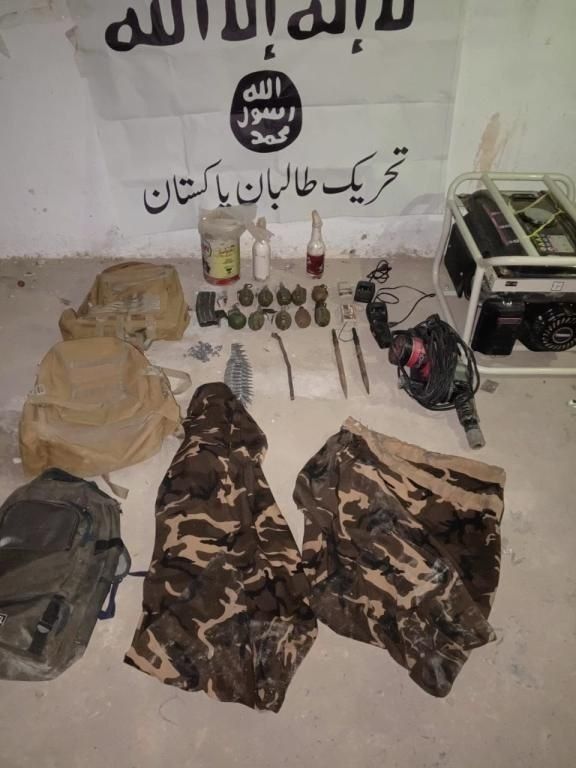
Pakistan Military Claims 74 Militants Killed in Operations Across Khyber Pakhtunkhwa and Balochistan