Pakistan Weekly Security Review: Militant Violence in KP, Expanding TTP Activity in Balochistan and Afghanistan Tensions
October 3–9, 2026
- شائع
- اپ ڈیٹ
- پڑھنے کا وقت
- 5 منٹ کی پڑھائی
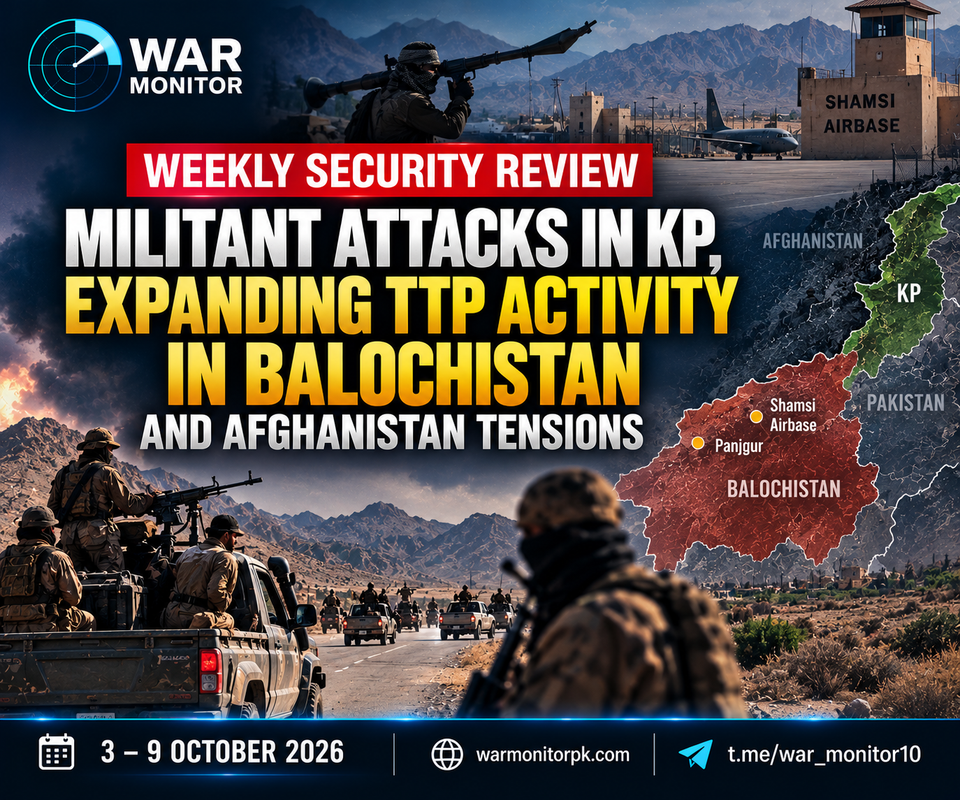
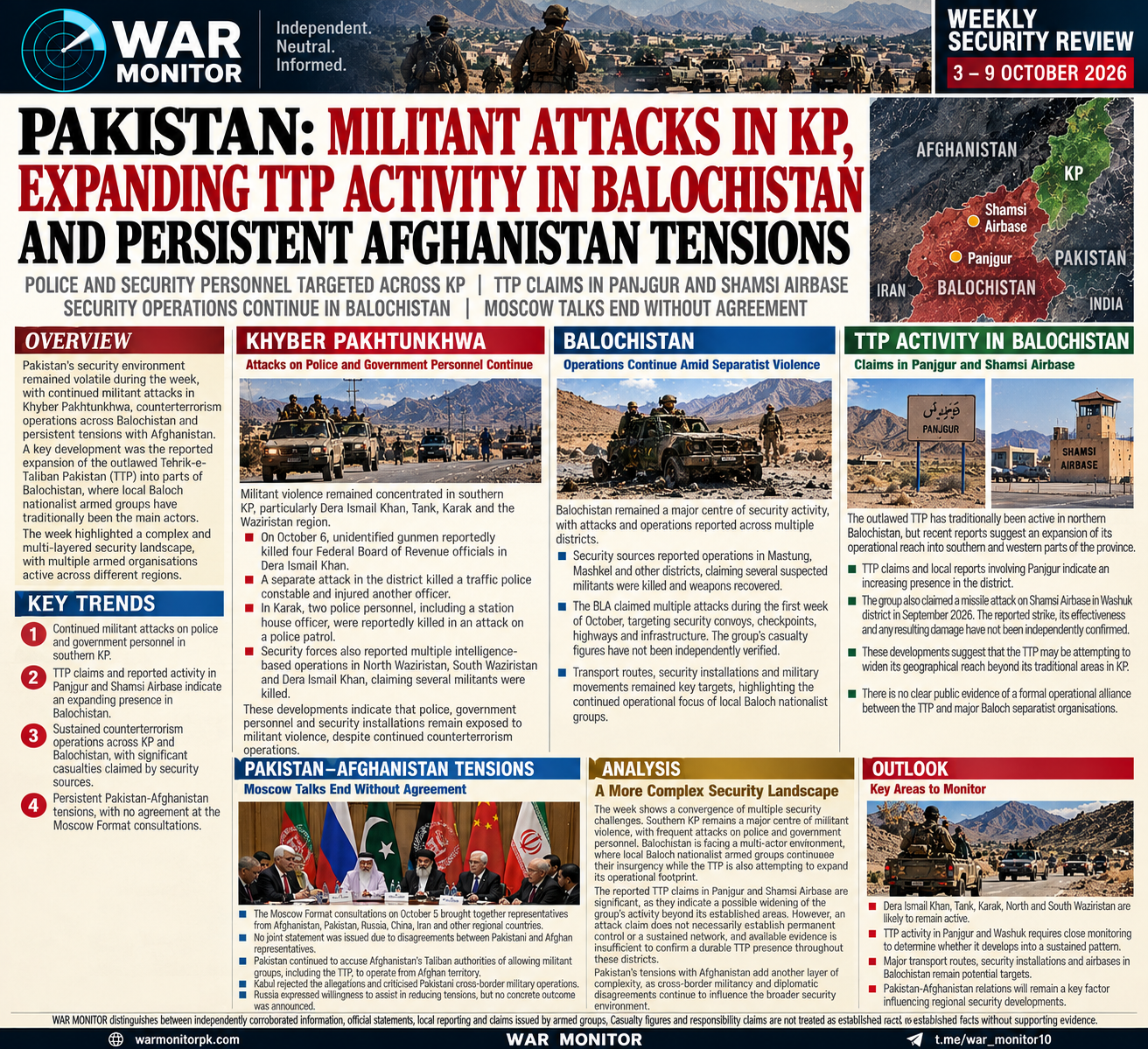
Pakistan’s security situation remained volatile during the week, with continued militant attacks in Khyber Pakhtunkhwa, counterterrorism operations in Balochistan and persistent tensions with Afghanistan.
An important development requiring closer attention is the reported expansion of the outlawed Tehrik-e-Taliban Pakistan (TTP) into parts of Balochistan, where Baloch nationalist armed organisations, particularly the Baloch Liberation Army (BLA) and Balochistan Liberation Front (BLF), have traditionally dominated separatist insurgent activity.
Reports and militant claims involving Panjgur and Shamsi Airbase suggest that Balochistan’s security challenges are becoming increasingly complex, with multiple armed organisations pursuing different objectives in the province.
Khyber Pakhtunkhwa: Continued Pressure on Security Forces
Militant violence remained concentrated in southern Khyber Pakhtunkhwa, particularly Dera Ismail Khan, Tank, Karak and the Waziristan region.
On October 6, unidentified gunmen reportedly killed four Federal Board of Revenue officials in Dera Ismail Khan. A separate attack in the district killed a traffic police constable and injured another officer.
In Karak, two police personnel, including a station house officer, were reportedly killed in an attack on a police patrol.
Meanwhile, Pakistani security forces reported intelligence-based operations in North Waziristan, South Waziristan and Dera Ismail Khan, claiming casualties among suspected militants.
These developments indicate that police, government personnel and security installations remain exposed to militant violence, despite continued counterterrorism operations.
Balochistan: An Increasingly Complex Security Environment
Balochistan continued to experience insurgent activity alongside operations by Pakistani security forces.
Security sources reported operations in Mastung, Mashkel and other districts, claiming several suspected militants were killed and weapons recovered.
Meanwhile, the BLA claimed responsibility for multiple attacks during the first week of October, targeting security personnel, convoys, checkpoints and infrastructure. The group’s casualty figures have not been independently verified.
However, Balochistan’s security situation can no longer be assessed solely through the activities of local Baloch nationalist armed groups. Reports involving the TTP suggest another dimension of militant activity that deserves separate analytical attention.
TTP’s Expanding Activity in Balochistan: Panjgur and Shamsi Airbase
The outlawed TTP has an established history of activity in northern Balochistan, particularly in areas adjoining Khyber Pakhtunkhwa and Afghanistan. However, developments during 2026 suggest that its claimed operational reach may be extending into districts farther south and west.
Among the notable developments are TTP-linked reports concerning Panjgur and the group’s September 2026 claim of an attack on Shamsi Airbase in Washuk district.
The TTP claimed to have targeted Shamsi Airbase with a missile. The reported strike, its effectiveness and any resulting damage have not been independently confirmed.
These developments are significant because Panjgur and Washuk lie outside the TTP’s more established areas of activity. They raise the possibility that the group is attempting to widen its geographical reach into parts of Balochistan historically associated with Baloch nationalist insurgency.
Nevertheless, an attack claim does not necessarily establish permanent organisational control or a sustained local network. The available evidence is insufficient to conclude that the TTP has established a durable presence throughout these districts.
There is also no clear public evidence establishing a formal operational alliance between the TTP and major Baloch separatist organisations.
The distinction is important. The TTP primarily pursues an Islamist militant agenda against the Pakistani state, whereas Baloch nationalist armed organisations pursue separatist political objectives. Their activities may increasingly overlap geographically without indicating a shared command structure or identical strategic goals.
For Pakistan’s security authorities, the emergence of multiple armed actors in overlapping geographical areas could complicate an already challenging security environment.
Pakistan-Afghanistan Relations
Regional security tensions continued to influence Pakistan’s security outlook during the week.
The October 5 Moscow Format consultations brought together Afghanistan, Pakistan and other regional countries, but disagreements over security and diplomatic issues continued.
Pakistan maintained its accusations that militant organisations, including the TTP, operate from Afghan territory. Afghanistan’s Taliban authorities rejected allegations of providing safe haven to groups carrying out attacks against Pakistan.
These disagreements remain important because cross-border militancy, border security and counterterrorism operations are increasingly connected to the broader diplomatic relationship between Islamabad and Kabul.
Weekly Security Assessment
The week’s developments highlight four important trends.
First, southern Khyber Pakhtunkhwa remains a major centre of militant violence, particularly in Dera Ismail Khan, Tank, Karak and Waziristan. Attacks on police and government personnel continue alongside security-force operations.
Second, Balochistan faces a multi-actor security challenge. Local Baloch nationalist armed groups remain active, while TTP claims involving Panjgur and Shamsi Airbase suggest a possible widening of the group’s operational geography.
Third, sustained counterterrorism operations have not eliminated the ability of armed groups to conduct geographically dispersed attacks. However, the available information does not establish whether these groups are gaining permanent territorial influence.
Fourth, Pakistan-Afghanistan tensions continue to complicate regional security cooperation and efforts to address cross-border militant activity.
Outlook
During the coming weeks, the security situation in Dera Ismail Khan, Tank, North and South Waziristan, Mastung, Panjgur, Washuk and Kharan will require particular attention.
For Balochistan, an important question is whether the TTP’s reported activities develop into a sustained pattern or remain isolated operations and claims.
The central assessment is that Balochistan’s militant landscape may be becoming more geographically and organisationally diverse. The simultaneous activities of separatist groups and the TTP could represent a more complicated security challenge, although evidence of permanent TTP expansion into Baloch-majority districts remains limited.
WAR MONITOR will continue to distinguish independently corroborated incidents from official statements, local reports and claims issued by armed organisations. Allegations of responsibility, casualty figures and claims of territorial expansion are not treated as established facts without supporting evidence.
WAR MONITOR
Website: warmonitorpk.com Telegram: t.me/war_monitor10
ذرائع اور تصدیق
میڈیا یا مقامی ذرائع کی رپورٹ۔ ہم دعووں پر لیبل کیسے لگاتے ہیں
اگلی خبر
متعلقہ خبریں
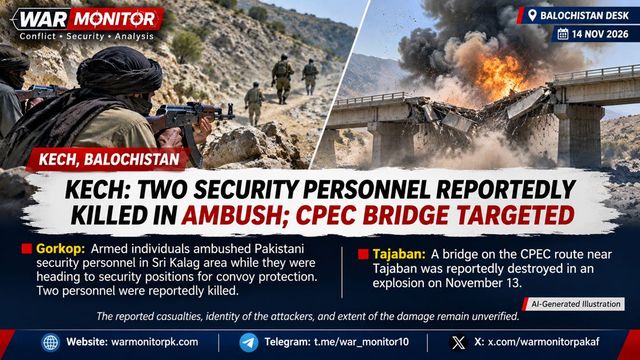
Two Pakistani Security Personnel Reportedly Killed in Kech Ambush; CPEC Route Bridge Destroyed
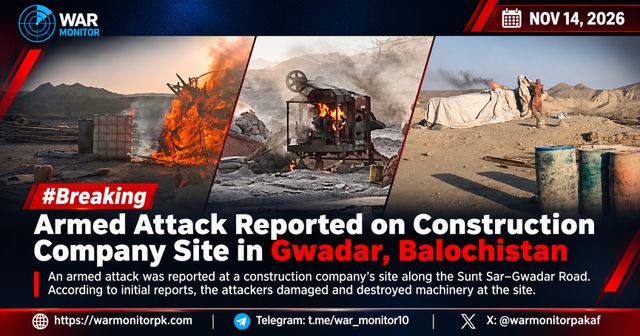
Armed Attack Reported on Construction Company Site in Gwadar, Balochistan
Pakistan Military Claims 74 Militants Killed in Operations Across Khyber Pakhtunkhwa and Balochistan
Baloch Nationalist Army Issues Statement Marking Baloch Martyrs’ Day on November 13
خطہ