Diplomatic Openings, the Smell of Explosives and the New Question of Proxy Warfare
- شائع
- اپ ڈیٹ
- پڑھنے کا وقت
- 9 منٹ کی پڑھائی
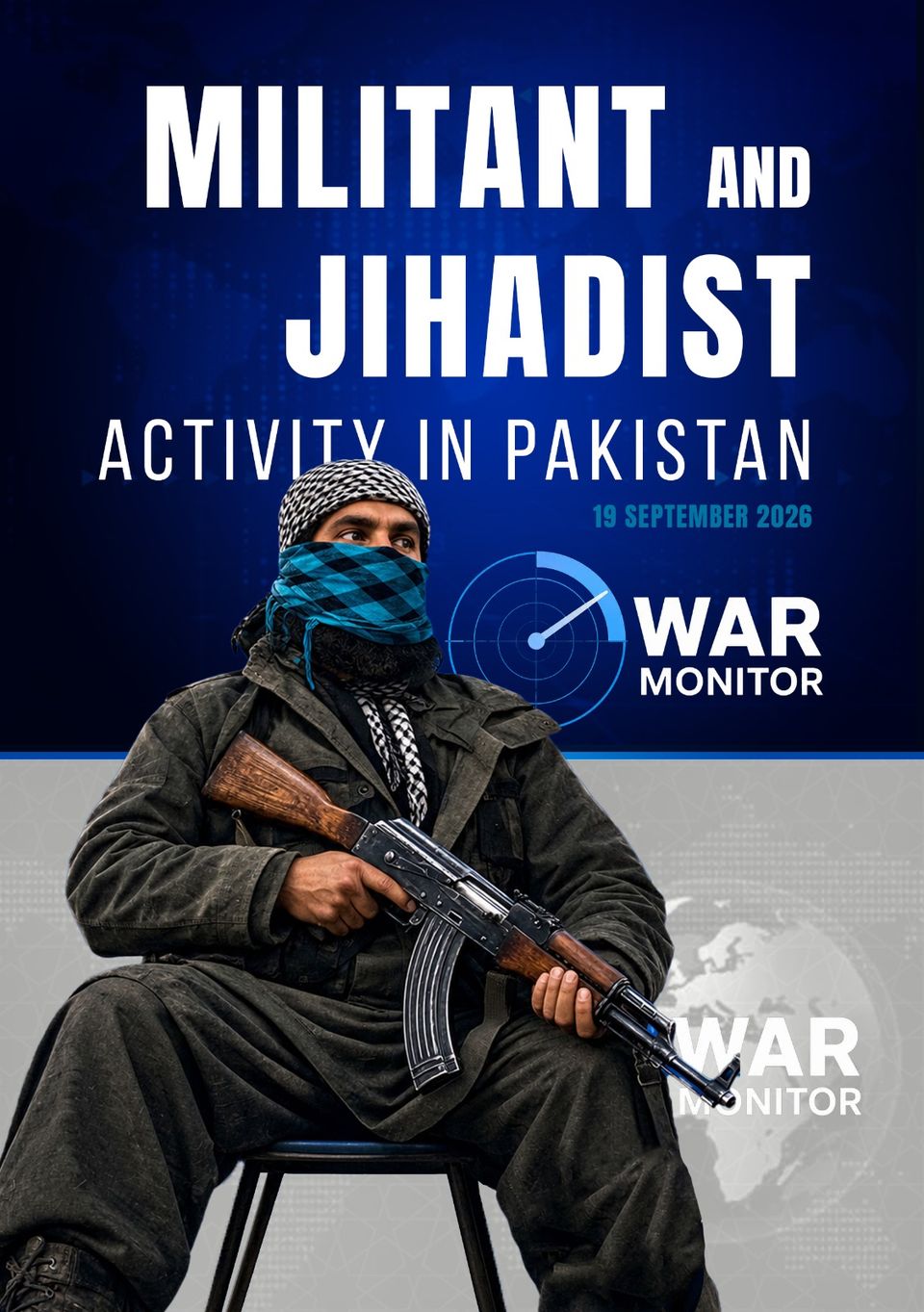
PDf File
Kabul’s Renewed Diplomatic Engagement, the Rise of Ittehad-ul-Mujahideen Pakistan and the Kohat Attack
WAR MONITOR | Special Analysis
By Attaullah Hafeez — WAR MONITOR Correspondent, Islamabad
Monitoring militant and jihadist activity in Pakistan
19 September 2026
Pakistan’s militant landscape appears to be entering another period of realignment. At the same time, Afghanistan has witnessed renewed diplomatic engagement involving senior Turkish and Qatari security officials, while relations between Kabul and Islamabad remain strained.
Against this backdrop, the major attack on the old Police Lines complex in Kohat has intensified debate over the emergence of Ittehad-ul-Mujahideen Pakistan (IMP), its relationship with other militant networks and whether the timing of escalating violence has any connection with wider regional developments.
The proximity of these developments raises legitimate analytical questions. It does not, however, by itself establish that the diplomatic activity and the attacks are causally connected.
Renewed Diplomacy Around Afghanistan
Türkiye’s intelligence chief İbrahim Kalın travelled to Kabul and Kandahar this week and held meetings with senior Afghan officials. Turkish sources said discussions covered security and intelligence cooperation, counterterrorism and regional developments. A senior Qatari security delegation was also in Kabul, and Afghan officials confirmed separate meetings involving Turkish and Qatari representatives.
Türkiye and Qatar have previously played mediating roles during periods of tension between Afghanistan and Pakistan. Some reporting on the latest visit has also linked the discussions to attempts to reduce those tensions, although the complete agenda has not been publicly disclosed.
The diplomatic activity therefore comes at an important moment: regional actors are again exploring dialogue while the security dispute between Kabul and Islamabad remains unresolved.
Kohat Changes the Security Conversation
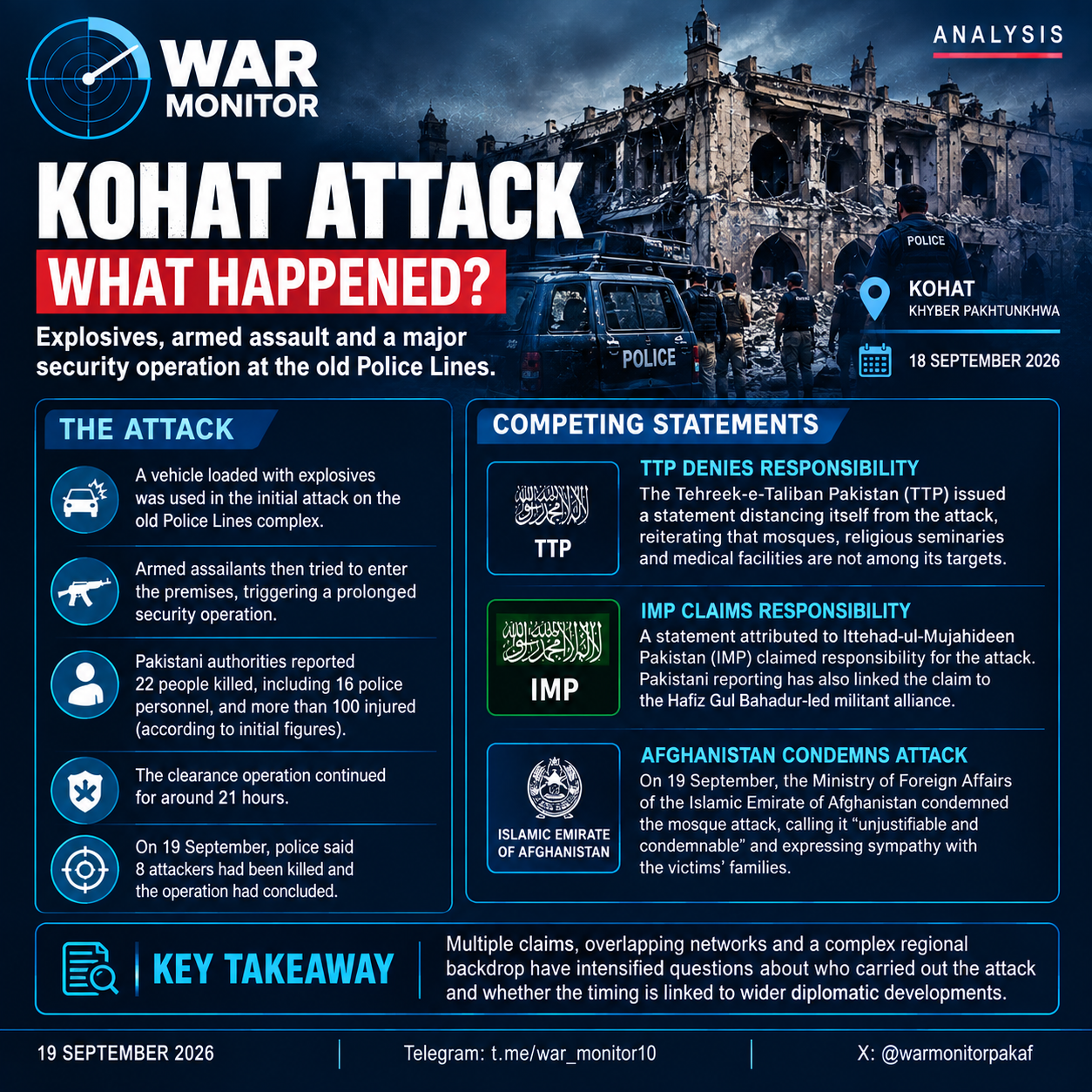
On September 18, a major attack struck the old Police Lines compound in Kohat, Khyber Pakhtunkhwa, during Friday prayers.
Police said an explosives-laden vehicle was used in the initial attack before armed assailants attempted to penetrate the complex, triggering a prolonged security operation. Pakistani authorities subsequently reported that 22 people, including 16 police personnel, were killed and more than 100 were injured.
The clearance operation continued overnight. On September 19, the Central Police Office said eight attackers had been killed and the operation had concluded.
Early casualty and attacker figures changed as the situation developed, and international reporting initially carried lower totals. The latest figures should therefore continue to be attributed to Pakistani authorities rather than treated as independently established totals.
IMP and the Question of Responsibility
A claim attributed to Ittehad-ul-Mujahideen Pakistan (IMP) brought the relatively new militant coalition into the centre of the discussion surrounding Kohat.
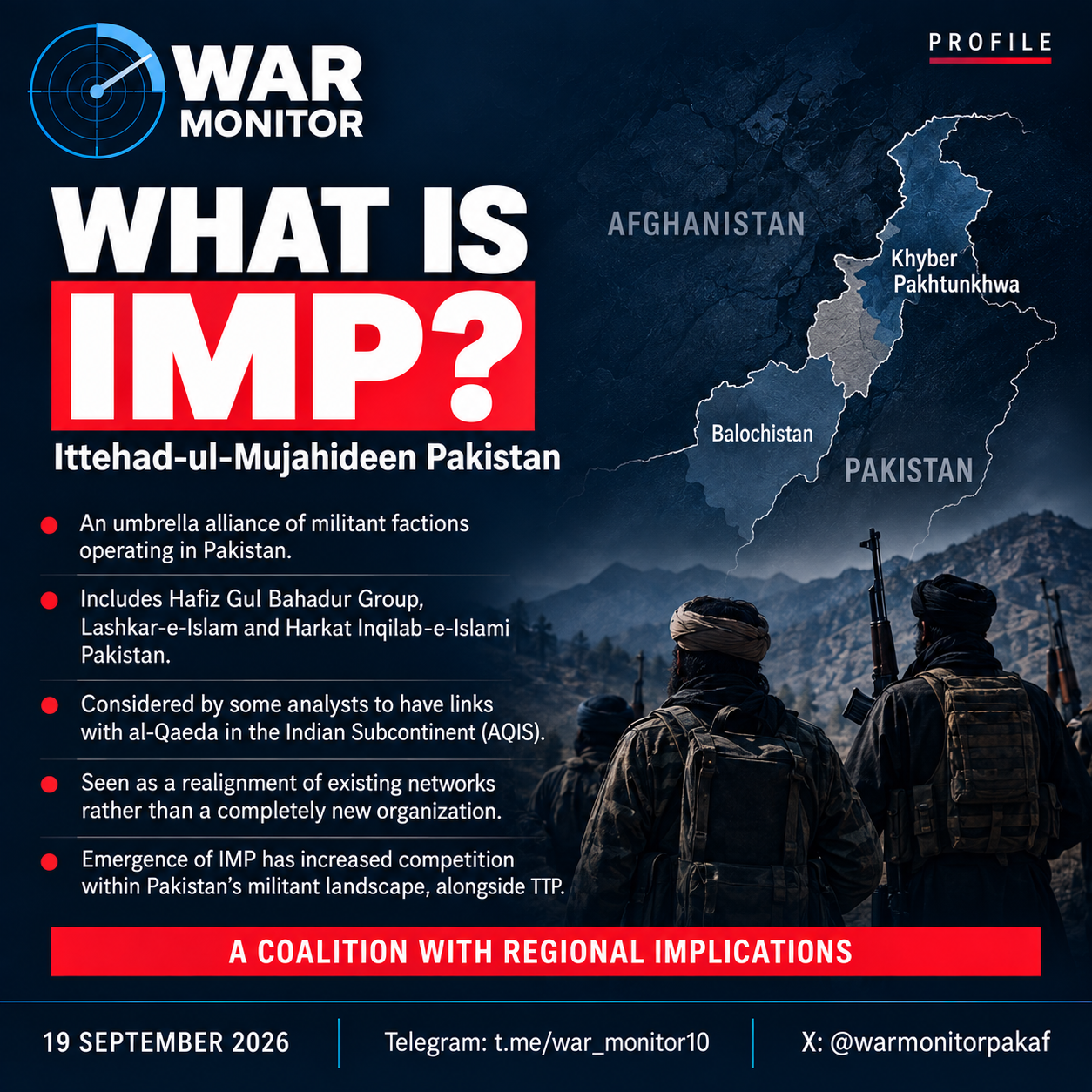
The emergence of IMP is important because it is not generally described as a completely new organization created from the ground up. Research and security assessments describe it as an umbrella alliance established in April 2025 bringing together the Hafiz Gul Bahadur Group, Lashkar-e-Islam and Harkat Inqilab-e-Islami Pakistan. The European Union Agency for Asylum similarly identifies Hafiz Gul Bahadur as heading the emerging alliance.
This distinction matters. IMP represents, at least in part, the regrouping of established militant networks under a common structure rather than the sudden appearance of an entirely unfamiliar organization.
Iftikhar Firdous and the AQIS Dimension
According to senior journalist Iftikhar Firdous, who monitors militant networks in the region, IMP should also be examined in the context of an alliance involving the Hafiz Gul Bahadur network, al-Qaeda in the Indian Subcontinent (AQIS) and Lashkar-e-Islam.
WAR MONITOR has not independently located the specific statement in which Firdous made this assessment, so his characterization should remain clearly attributed to him.
There is, however, separate research supporting examination of an AQIS dimension.
A recent Pakistan Institute for Conflict and Security Studies analysis, citing a UN assessment, reported that AQIS formed the “backbone” of IMP and noted that an AQIS publication had featured IMP attacks alongside those of other al-Qaeda regional affiliates.
Other independent monitoring has been more cautious, noting possible AQIS links while saying firm evidence was insufficient at the time of assessment.
Taken together, these assessments make AQIS’s potential relationship with IMP an important subject for further investigation, but they do not establish every aspect of the coalition’s command or operational structure.
TTP Denies Responsibility
Another important development came from the Tehreek-e-Taliban Pakistan (TTP).
Following the Kohat attack, TTP issued a statement distancing itself from the incident and reiterated its stated position that mosques, religious seminaries and medical facilities are not among its targets.
This denial is significant because IMP and TTP operate within overlapping militant environments, but they should not automatically be treated as a single organization.
The distinction raises a broader question: are TTP and IMP cooperating, competing, or doing both depending on location and circumstances?
IMP’s emergence potentially creates another centre of militant organization alongside TTP. Research published by Jamestown describes the coalition as an umbrella alliance dominated by the experienced Hafiz Gul Bahadur faction and notes growing competition within Pakistan’s militant landscape.
A denial by TTP does not independently establish who carried out the attack, just as a militant organization’s claim of responsibility requires corroboration.
Afghanistan Formally Condemns the Kohat Mosque Attack
Kabul also issued an official response on September 19.
The Ministry of Foreign Affairs of the Islamic Emirate of Afghanistan strongly condemned the attack on the Kohat mosque during Friday prayers. It described attacks on holy places as unjustifiable and condemnable and expressed sympathy with the families of the victims.
The distinction is important: the Afghan statement was an official condemnation of the attack, rather than a specific denial of Afghan involvement.
This response nevertheless carries political significance because Pakistan and Afghanistan remain divided over accusations concerning militant sanctuaries and cross-border security.
The Afghan condemnation should therefore be recorded as part of the diplomatic response to Kohat, but it does not by itself establish the identity, location or external supporters of those responsible.
TTP, IMP and an Increasingly Fragmented Militant Landscape
The competing positions following Kohat illustrate how complicated Pakistan’s militant environment has become.
TTP has spent years attempting to absorb or reconcile fragmented militant factions under its own organizational umbrella. IMP, meanwhile, has provided another framework for established factions retaining separate histories and networks.
The Hafiz Gul Bahadur Group is particularly important in this equation. European asylum research describes it as the dominant force behind IMP while also documenting movement of commanders between Gul Bahadur’s network and TTP.
Such fluidity means organizational labels alone may not always explain relationships on the ground.
Groups may compete for fighters and influence while simultaneously maintaining personal, ideological or historical connections.
Does the Timing of the Violence Matter?
The most politically sensitive question concerns timing.
Senior Turkish and Qatari officials were holding security-related discussions with Afghan leaders just as the region was again confronting serious militant violence. The Turkish intelligence chief’s visit extended from Kabul to Kandahar, followed by contacts involving Pakistan.
Then came Kohat.
This sequence inevitably generates speculation that violence may be intended to complicate diplomatic normalization, reinforce perceptions of regional instability or influence negotiations.
Those possibilities can legitimately be investigated.
But correlation is not evidence of coordination.
Establishing that the Kohat attack was deliberately timed to undermine Kabul’s diplomatic engagement would require evidence showing that those planning the attack knew of, responded to or sought to influence those diplomatic developments.
No independently verified public evidence currently establishes such a connection.
The Proxy-Warfare Question
The Afghanistan-Pakistan theatre has a long history of states, intelligence services, militant organizations and local armed networks forming relationships that change over time.
That history makes questions about proxies unavoidable.
Some observers have consequently raised allegations that Pakistani intelligence institutions could prefer alternative militant networks capable of counterbalancing TTP or fragmenting its influence.
Within this interpretation, the emergence of IMP is sometimes presented as potentially serving such a purpose.
This remains an unproven hypothesis.
WAR MONITOR has not identified independently verified evidence establishing that Pakistan’s Inter-Services Intelligence (ISI) created IMP, controls the alliance or directed the Kohat attack.
This evidentiary distinction is crucial.
A state having historical contacts with militants, attempting to influence an armed organization, benefiting from divisions among militants and directly ordering an attack are four different propositions. Evidence for one does not automatically prove the others.
Why the AQIS Question Matters
AQIS adds another dimension.
Al-Qaeda has historically relied heavily on relationships with locally rooted organizations. A meaningful AQIS role inside IMP would therefore raise questions extending beyond Pakistan’s domestic militant competition.
The recent PICSS analysis citing a UN assessment points to a substantial AQIS connection, while earlier independent monitoring was more cautious about how firmly that relationship could be established.
The central question is therefore not simply whether AQIS and IMP have contacts.
Investigators need to determine whether AQIS provides ideological guidance, organizational expertise, training, facilitation or other forms of support—and how much influence it actually exercises over decision-making.
What Kohat Leaves Unanswered
The Kohat attack has made several questions more urgent.
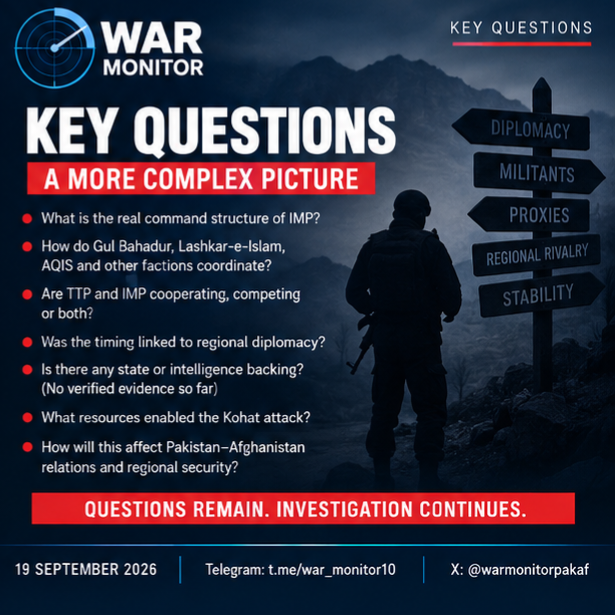
Who exercises effective command within IMP? How are the Hafiz Gul Bahadur Group, Lashkar-e-Islam and Harkat Inqilab-e-Islami Pakistan connected at the leadership level? What is AQIS’s actual role? How does IMP relate to TTP? And what resources enabled those responsible for the Kohat attack to mount such a major assault on a heavily secured police facility?
There is also the broader geopolitical question: was the timing unrelated to the diplomatic activity surrounding Afghanistan, or was someone attempting to exploit a politically sensitive moment?
These questions cannot reliably be answered through militant propaganda, anonymous allegations or timing alone.
Financial trails, communications, arrests, forensic evidence, judicial proceedings and independently corroborated intelligence would provide a stronger basis for conclusions.
Assessment
Three developments can presently be established separately.
First, Türkiye and Qatar have been conducting high-level security diplomacy with Afghanistan, amid continuing tensions between Kabul and Islamabad.
Second, IMP is an established umbrella alliance involving the Hafiz Gul Bahadur Group, Lashkar-e-Islam and Harkat Inqilab-e-Islami Pakistan, while credible research has raised the possibility of a deeper AQIS role.
Third, the Kohat Police Lines suffered a major attack on September 18, followed by a lengthy clearance operation. TTP subsequently distanced itself from the attack, while Afghanistan’s Foreign Ministry formally condemned the mosque attack on September 19.
What has not been established is equally important.
There is currently insufficient independently verified evidence to demonstrate a direct causal chain connecting Kabul’s diplomatic engagement, the Kohat attack, IMP’s emergence and an alleged Pakistani intelligence strategy.
Conclusion
The significance of Kohat extends beyond a single attack.
It has placed Ittehad-ul-Mujahideen Pakistan under greater scrutiny and highlighted a militant landscape in which old organizations are reorganizing, alliances are shifting and the boundaries between cooperation and rivalry are becoming increasingly difficult to define.
The assessment attributed to Iftikhar Firdous regarding the Gul Bahadur, AQIS and Lashkar-e-Islam nexus provides one analytical framework for examining IMP. Separate research confirming the coalition’s principal constituent groups and raising the possibility of an important AQIS role gives that question additional relevance.
At the same time, TTP’s denial and the Islamic Emirate of Afghanistan’s formal condemnation should be recorded accurately rather than interpreted beyond what their respective statements establish.
The larger proxy-war hypothesis remains worthy of investigation—but investigation should precede conclusion.
For now, the clearest development is that Pakistan’s militant landscape is undergoing another significant realignment at precisely the moment when regional actors are attempting renewed diplomacy around Afghanistan.
Whether those two trajectories are connected remains an open question.
Independent verification of disputed organizational, intelligence and proxy-related claims is pending.
Attaullah Hafeez
WAR MONITOR Correspondent — Islamabad
Monitoring militant and jihadist activity in Pakistan
19 September 2026
https://t.me/war_monitor10
ذرائع اور تصدیق
میڈیا یا مقامی ذرائع کی رپورٹ۔ ہم دعووں پر لیبل کیسے لگاتے ہیں
اگلی خبر
متعلقہ خبریں
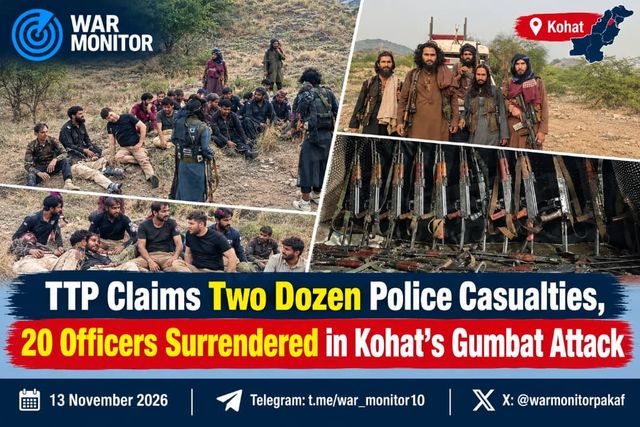
TTP Claims Two Dozen Police Casualties, 20 Officers Surrendered in Kohat’s Gumbat Attack
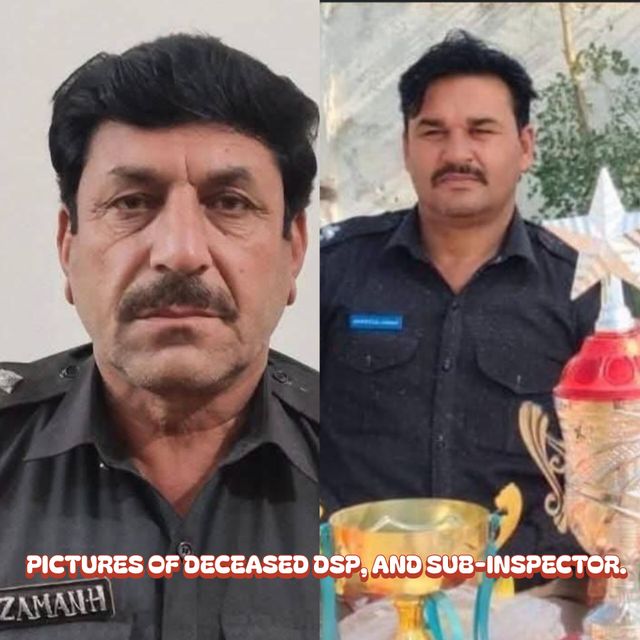
TTP-Linked Sources Claim Responsibility for Kohat Police Ambush; Reports Say 10 Officers Killed
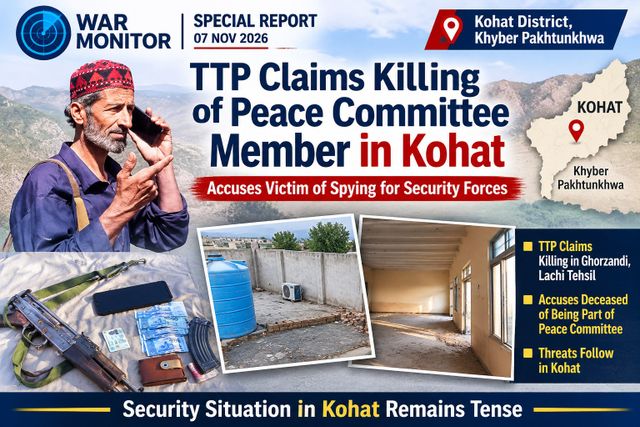
ٹی ٹی پی کا ضلع کوہاٹ میں مبینہ امن کمیٹی رکن کو قتل کرنے کا دعویٰ
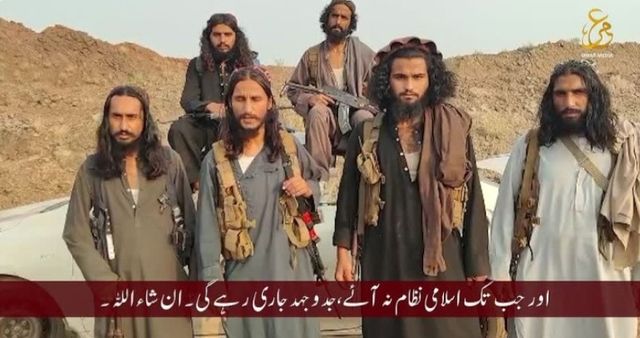
ٹی ٹی پی کی جاری کردہ ویڈیو میں کوہاٹ اور جنوبی پنجاب میں پولیس پر حملوں کا دعویٰ
خطہ