TTP’s Expanding Footprint in Balochistan: A Changing Security Landscape
- Published
- Updated
- Reading time
- 8 min read
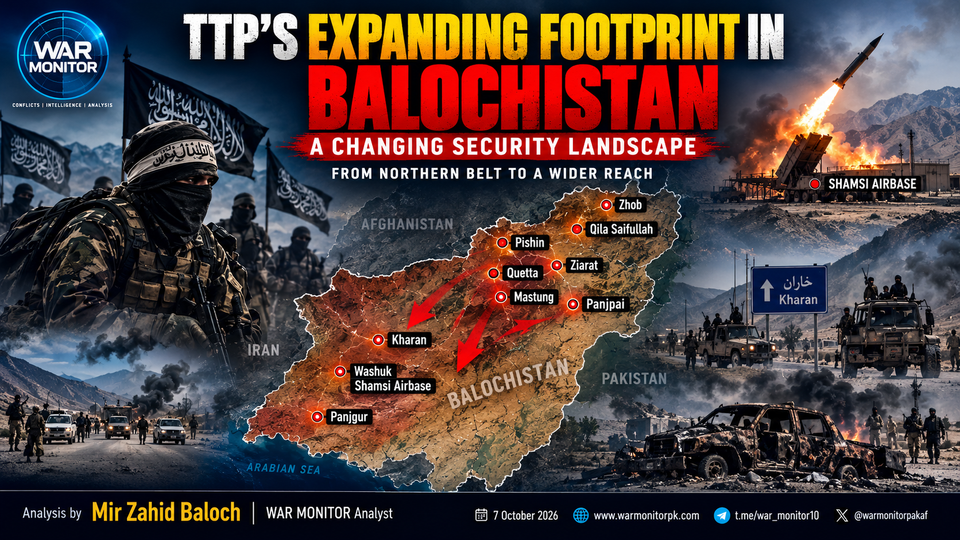
TTPs_Expanding_Footprint_in_Balochistan_WAR_MONITOR
October 7, 2026 | Analysis by Mir Zahid Baloch — WAR MONITOR Analyst
Balochistan’s security landscape is undergoing a significant transformation. For years, the province has primarily been associated with the insurgency led by Baloch separatist organisations, particularly the Balochistan Liberation Army (BLA) and Balochistan Liberation Front (BLF). Developments during 2025 and, more noticeably, 2026, however, suggest that the outlawed Tehrik-e-Taliban Pakistan (TTP) is also attempting to broaden its geographical and operational footprint in the province.
It would be premature to conclude that the TTP has established the kind of organisational presence in Balochistan that it maintains in parts of Khyber Pakhtunkhwa. Nevertheless, when militant claims, security operations and locally reported incidents are examined collectively, there are indications that TTP-linked activity may no longer be confined to Balochistan’s predominantly Pashtun northern districts.
Beyond the Traditional Northern Belt
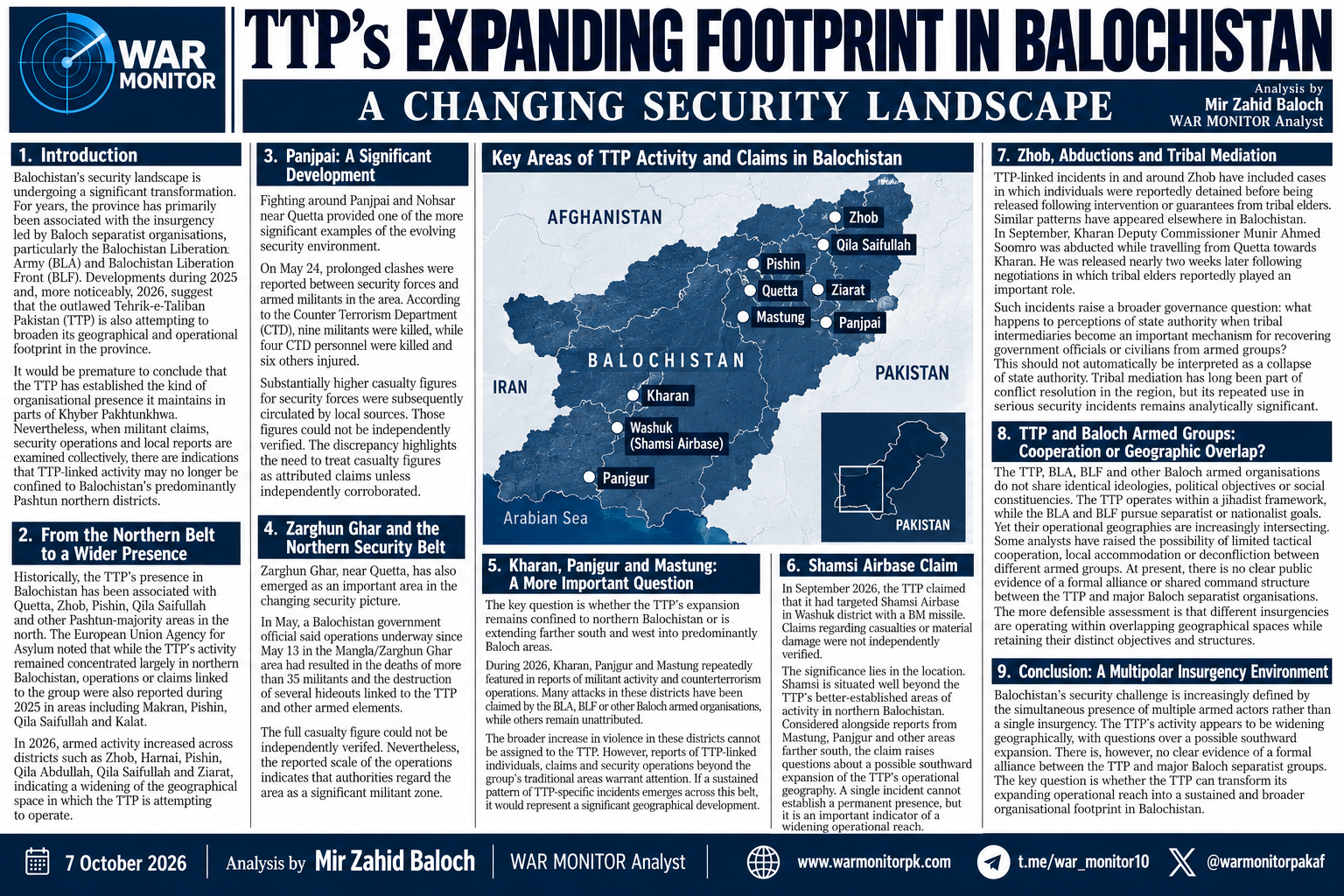
Historically, the TTP’s presence in Balochistan has been associated primarily with Quetta, Zhob, Pishin, Qila Saifullah and other Pashtun-majority areas in the north.
The European Union Agency for Asylum (EUAA) noted that while the TTP’s activity remained concentrated largely in northern Balochistan, operations or claims linked to the group were also reported during 2025 in areas including Makran, Pishin, Qila Saifullah and Kalat.
The pattern became more pronounced during 2026. Armed activity increased across districts including Zhob, Harnai, Pishin, Qila Abdullah, Qila Saifullah and Ziarat, adding another layer to an already complicated insurgent environment.
The significance lies not simply in the number of individual attacks, but in the apparent widening of the geographical space in which the TTP is attempting to operate.
Panjpai: A Significant Development
The fighting around Panjpai and Nohsar, near Quetta, provided one of the more significant examples of the evolving security environment.
On May 24, prolonged clashes were reported between security forces and armed militants in the area. According to the Counter Terrorism Department (CTD), nine militants were killed, while four CTD personnel were killed and six others injured.
Substantially higher casualty figures for security forces were subsequently circulated by local sources. Those figures could not be independently verified.
The discrepancy is itself important. Casualty figures issued by state institutions, militant organisations and local networks frequently differ considerably in Balochistan. For this reason, such figures should be treated as attributed claims unless independently corroborated.
Zarghun Ghar and the Northern Security Belt
Zarghun Ghar, near Quetta, has also emerged as an important area in the changing security picture.
In May, a Balochistan government official said operations underway since May 13 in the Mangla/Zarghun Ghar area had resulted in the deaths of more than 35 militants and the destruction of several hideouts linked to the TTP and other armed elements.
The full casualty figure could not be independently verified. Nevertheless, the reported scale and duration of the security operations indicate that authorities regarded the area as a significant militant security zone.
Taken together with developments in Pishin, Zhob, Ziarat and the Quetta periphery, the incidents point towards a broader northern Balochistan belt where TTP-linked activity has become increasingly prominent.
Kharan, Panjgur and Mastung: A More Important Question
The more consequential question is whether the TTP’s expansion remains confined to northern Balochistan or is extending farther south and west into predominantly Baloch areas.
During 2026, Kharan, Panjgur and Mastung repeatedly featured in reports of militant activity and counterterrorism operations. However, considerable caution is necessary when interpreting these developments.
Many attacks in these districts have been claimed by the BLA, BLF or other Baloch armed organisations, while others remain unattributed. The broader increase in violence in these districts therefore cannot be assigned to the TTP.
Nevertheless, reports of TTP-linked individuals, claims and security operations beyond the group’s traditional northern areas warrant attention. If a sustained pattern of TTP-specific incidents emerges across the Kharan-Panjgur-Mastung belt, it would represent a significant geographical development.
The key distinction is between an organisation being capable of conducting an isolated operation in an area and establishing a durable network there. Current evidence supports continued monitoring of the trend but does not yet establish a permanent TTP presence across this entire belt.
The Shamsi Airbase Claim
One of the most notable geographical indicators emerged in Washuk district.
In September 2026, the TTP claimed that it had targeted Shamsi Airbase with a BM missile. Claims regarding casualties or material damage were not independently verified.
The significance of the incident lies less in the group’s claims about its impact and more in its location.
Shamsi is situated well beyond the TTP’s better-established areas of activity in northern Balochistan. A TTP-claimed operation in Washuk therefore raises questions about whether the group is attempting to develop an operational reach deeper into western and southwestern Balochistan.
The Shamsi claim alone cannot establish a permanent organisational presence in Washuk. However, considered alongside reports emerging from Mastung, Panjgur and other areas farther south, it adds weight to the need to examine a possible southward expansion of the TTP’s operational geography.
Zhob, Abductions and Tribal Mediation
Another feature of the changing security environment is the role of abduction, detention and tribal mediation.
TTP-linked incidents in and around Zhob have included cases in which individuals were reportedly detained before being released following intervention or guarantees from tribal elders.
Similar patterns have appeared elsewhere in Balochistan, although not necessarily involving the TTP.
In September, Kharan Deputy Commissioner Munir Ahmed Soomro was abducted while travelling from Quetta towards Kharan. He was released nearly two weeks later following negotiations in which tribal elders reportedly played an important role.
Such incidents raise a broader governance question: what happens to perceptions of state authority when tribal intermediaries become an important mechanism for recovering government officials or civilians from armed groups?
This should not automatically be interpreted as evidence of the collapse of state authority. Tribal mediation has long been part of conflict resolution in the region and can operate alongside formal security mechanisms. But its repeated use in serious security incidents remains analytically significant.
TTP and Baloch Armed Groups: Cooperation or Geographic Overlap?
This is perhaps the most sensitive question surrounding the emerging security environment.
The TTP, BLA, BLF and other Baloch armed organisations do not share identical ideologies, political objectives or social constituencies.
The TTP operates primarily within a jihadist framework, while the major Baloch armed organisations pursue separatist or nationalist objectives.
Yet their operational geographies are increasingly intersecting.
Some analysts have raised the possibility of limited tactical cooperation, local accommodation or deconfliction between different armed groups. Others argue that the pattern may simply reflect separate organisations exploiting security vulnerabilities in the same geographical environment.
At present, publicly available evidence does not establish a formal alliance, shared command structure or systematic operational partnership between the TTP and major Baloch separatist organisations.
The more defensible assessment is that different insurgencies are increasingly operating within overlapping geographical spaces while retaining their distinct objectives and organisational structures.
Even without formal cooperation, such overlap creates a more complicated security challenge for the Pakistani state.
Balochistan’s Emerging Multipolar Insurgency Environment
The most important development in 2026 may therefore be that violence in Balochistan can no longer be understood exclusively through the lens of a single insurgency.
Baloch separatist organisations continue to conduct attacks across southern, central and western Balochistan. At the same time, TTP activity has become increasingly visible across the province’s northern districts.
More importantly, TTP claims and reports of TTP-linked activity have begun to raise questions about areas outside its traditional Pashtun-majority operating environment.
This creates what can increasingly be described as a multipolar insurgency environment: several armed organisations with different ideologies and political objectives exerting pressure on the state across adjoining or, in some cases, overlapping geographical zones.
That distinction is important. An increase in violence in Balochistan does not necessarily indicate cooperation among the groups responsible for it.
WAR MONITOR Assessment
The available evidence supports several cautious conclusions.
First, the geographical footprint of TTP activity in Balochistan appears to be widening, with the strongest evidence remaining in the northern Pashtun-majority belt.
Second, developments involving Mastung, Panjgur, Kharan and Washuk, including the TTP’s claim concerning Shamsi Airbase, raise a legitimate question over whether the group is attempting to establish a more sustained presence farther into predominantly Baloch areas. The available evidence, however, is not yet sufficient to conclude that it has established a durable network throughout this belt.
Third, there is currently no clear public evidence of a formal alliance between the TTP and major Baloch separatist organisations. Geographic overlap or even isolated tactical accommodation should not be conflated with a unified insurgent command.
Finally, Balochistan’s security challenge is increasingly defined by the simultaneous presence of multiple armed actors rather than a single insurgency.
The central question is therefore no longer whether the TTP has a presence in Balochistan. That presence predates the current period.
The more important question is whether the group can transform its expanding operational reach from northern Balochistan into a durable and geographically broader organisational footprint extending into the province’s Baloch-majority areas.
The answer will depend on whether the incidents observed during 2026 develop into a sustained pattern of attacks, networks and organisational activity or remain a collection of geographically dispersed operations.
For now, the evidence points towards an expanding and increasingly complex militant landscape — but one in which the boundaries between presence, operational reach and permanent territorial entrenchment must be carefully distinguished.
Analysis by Mir Zahid Baloch — WAR MONITOR Analyst
X: https://x.com/warmonitorpakaf
Telegram: https://t.me/war_monitor10
Sources & verification
Reported by media or local sources. How we label claims
Read next
Related coverage
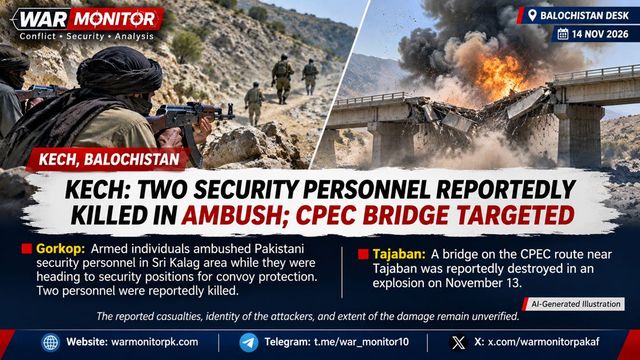
Two Pakistani Security Personnel Reportedly Killed in Kech Ambush; CPEC Route Bridge Destroyed
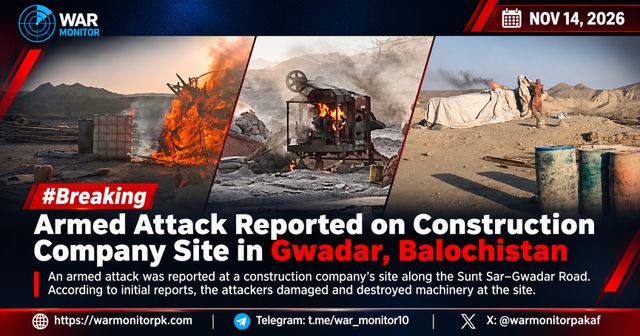
Armed Attack Reported on Construction Company Site in Gwadar, Balochistan
Pakistan Military Claims 74 Militants Killed in Operations Across Khyber Pakhtunkhwa and Balochistan
Baloch Nationalist Army Issues Statement Marking Baloch Martyrs’ Day on November 13
Region