Ali al-Taher Heights: A Strategic Flashpoint in Southern Lebanon
- Published
- Updated
- Reading time
- 4 min read
WAR MONITOR Analysis | September 16, 2026
Analyst: Abdul Wahid | Lebanon
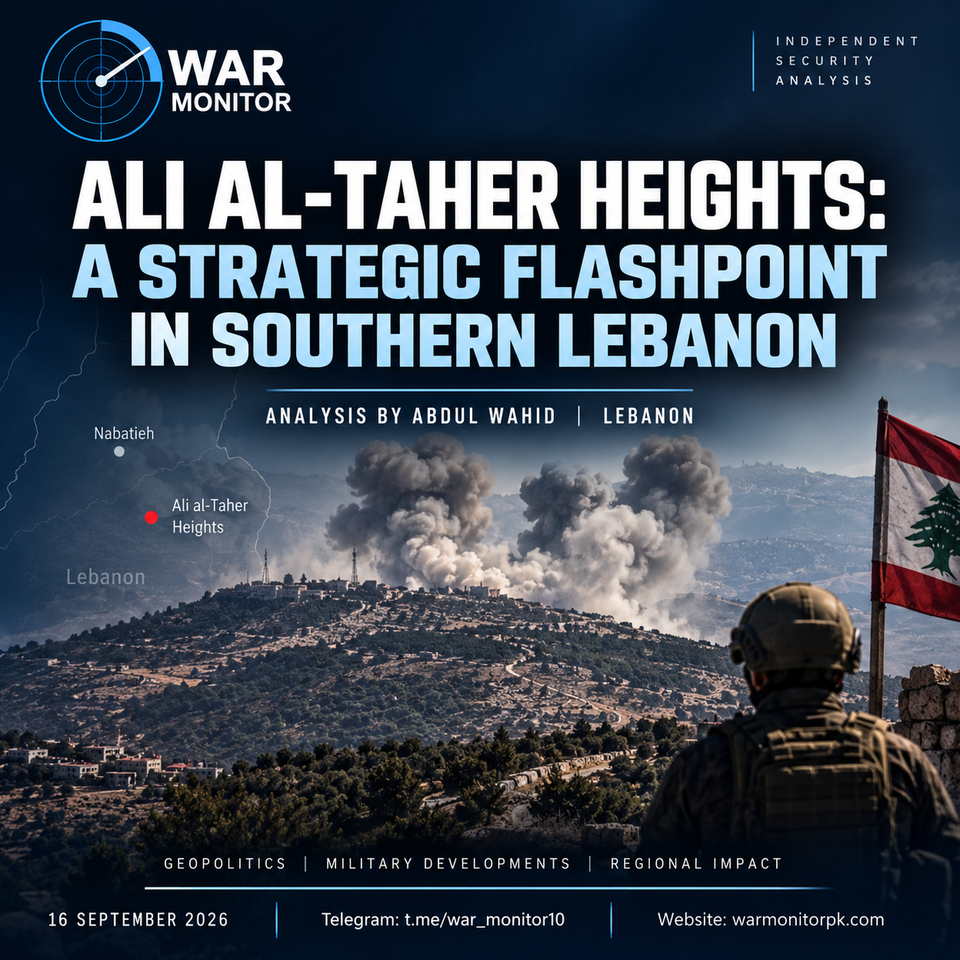
Ali al-Taher Heights, near Nabatieh in southern Lebanon, has emerged as an important focus of the continuing military confrontation between Israel and Hezbollah. Recent Israeli operations, the reported destruction of Hezbollah-linked underground infrastructure, and uncertainty over Israel’s future military deployment have given the ridge significance beyond the immediate battlefield.
Why Ali al-Taher Matters
Ali al-Taher is a strategically elevated area in southern Lebanon, roughly 15 kilometres from the Israeli border. Its terrain provides a commanding position over surrounding areas and routes, making control of the ridge militarily significant.
In early September, the Israeli military said it had established “operational control” over both the surface and underground areas of the ridge. On September 10, Israeli forces carried out a series of major demolitions targeting what they described as Hezbollah underground infrastructure.
The explosions were reportedly felt across Nabatieh and surrounding areas.
The Underground Network
According to the Israeli military, the underground complex extended for more than two kilometres and contained command facilities, weapons-storage areas and living quarters. Israel linked the infrastructure to Hezbollah’s Badr Unit and said weapons, including rockets, missiles and drones, were found at the site.
These details largely originate from Israeli military statements. The full scale and function of the underground network, as well as the extent of its destruction, have not been independently verified.
What Is Israel Trying to Achieve?
Israel says its operations at Ali al-Taher are intended to prevent Hezbollah from rebuilding military infrastructure that could threaten northern Israel.
Following the September 10 operation, Israeli Prime Minister Benjamin Netanyahu and Defence Minister Israel Katz indicated that Israeli forces would maintain measures aimed at preventing Hezbollah from re-establishing itself in the area.
Subsequent reports, however, indicated that some Israeli forces could be repositioned toward more defensible rear positions.
This distinction is important: a redeployment of forces does not necessarily amount to a complete Israeli withdrawal from the area.
Implications for Hezbollah
The importance of Ali al-Taher extends beyond control of a single ridge.
If Israel has substantially disabled the underground infrastructure as claimed, Hezbollah could face difficulties in restoring its local command, logistics and movement networks. However, there is currently insufficient independent evidence to determine how significantly these operations have affected Hezbollah’s broader military capabilities in southern Lebanon.
The longer-term impact will depend partly on whether Hezbollah can rebuild infrastructure in the area and whether Israel retains the ability to monitor or strike attempts to do so.
Iran’s Role: Silence or Limited Response?
Iran cannot accurately be described as completely silent or unaware of developments at Ali al-Taher.
Before the major Israeli operation, reports indicated that Tehran had warned the United States against an Israeli advance in the area and raised the prospect of a strong response.
Following the September 10 demolitions, however, no major direct Iranian action emerged that visibly altered the military situation at Ali al-Taher.
A more cautious assessment is therefore that Iran was not politically or diplomatically disengaged from the issue, but its direct practical role in preventing the Israeli operation appeared limited.
A Test for Southern Lebanon’s Security Order
Ali al-Taher is also connected to a broader question: who will ultimately exercise effective security control in southern Lebanon?
Lebanon seeks to reinforce state sovereignty and expand the Lebanese Armed Forces’ authority, while Hezbollah’s weapons and military infrastructure remain a central point of dispute. Israel, meanwhile, argues that it requires security guarantees preventing Hezbollah from rebuilding positions that could threaten its northern communities.
Any prolonged Israeli military presence inside Lebanon would also raise questions concerning Lebanese sovereignty and territorial integrity.
These competing objectives make locations such as Ali al-Taher particularly important to any future security arrangement.
What Comes Next?
Several outcomes remain possible.
Israel could complete its immediate operations and move most troops to rear defensive positions while maintaining surveillance and strike capabilities over the ridge. Alternatively, it could retain a limited or semi-permanent presence if Israeli authorities assess that Hezbollah is attempting to rebuild military infrastructure.
A broader diplomatic arrangement could eventually produce further withdrawals and transfer responsibility to Lebanese state forces, although such an outcome would depend on wider negotiations and developments on the ground.
WAR MONITOR Assessment
Ali al-Taher should not be viewed solely as the site of an operation against an underground tunnel network. The more consequential issue is the emerging post-conflict security and territorial arrangement in southern Lebanon.
Israel is seeking to prevent Hezbollah from rebuilding military infrastructure near its northern frontier. Hezbollah faces the challenge of preserving its position and capabilities in southern Lebanon, while the Lebanese state faces pressure to assert sovereignty and expand its security authority.
The key indicator in the coming period will be whether Israel maintains troops on or around strategic heights such as Ali al-Taher, shifts toward surveillance and stand-off military control, or withdraws further under a broader political and security arrangement.
For now, available reporting points more clearly to a reorganisation of Israeli military positions than to an unequivocal, complete withdrawal from Ali al-Taher.
WAR MONITOR — Independent Security & Conflict Analysis
Sources & verification
Reported by media or local sources. How we label claims
Read next
Related coverage

Body of Alleged Abduction Victim Recovered in Bannu After Ten Days
Armed Attack Reported on Construction Company Site in Gwadar, Balochistan
Pakistan Military Claims 74 Militants Killed in Operations Across Khyber Pakhtunkhwa and Balochistan